
If you’re building a leveraged ETF list for your watchlist, you already know these funds aren’t your typical buy and hold investments. Leveraged ETFs are designed to multiply the daily returns of an underlying index often by 2x or 3x giving traders a way to amplify gains (and losses) without using margin or options. Whether you’re bullish on tech, bearish on the broader market, or just trying to understand how these products fit into a portfolio, this guide breaks down the leveraged ETF landscape.
What Is a Leveraged ETF, Exactly?
A leveraged ETF uses financial derivatives swaps, futures, and options to magnify the daily performance of a benchmark index. If the S&P 500 rises 1% in a day, a 2x leveraged S&P 500 ETF aims to rise roughly 2%. Drop 1%, and that same fund aims to fall about 2%.
Leveraged ETFs are designed to amplify the daily returns of an underlying index, sector, or commodity using financial derivatives and borrowed capital. These funds typically provide 2× or 3× the daily performance (or inverse performance) of their benchmark. Popular leveraged ETFs include TQQQ, SQQQ, SOXL, SPXL, and TECL, which allow traders to capitalize on short-term market trends in technology, semiconductors, the S&P 500, energy, and other sectors. Because leveraged ETFs reset daily, they are generally intended for short-term trading rather than long-term investing due to the effects of compounding and volatility.
Leveraged ETFs reset their exposure every trading day, which means their returns compound over time rather than simply tracking a multiple of the index’s long-term performance. This is why leveraged ETFs are generally viewed as short-term trading tools rather than long-term holdings a concept every investor should understand before adding one to a portfolio.
Leveraged ETF List
| ETF Name | Symbol | Leverage | Tracks | Primary Trend |
|---|---|---|---|---|
| ProShares UltraPro QQQ | TQQQ | 3× Bull | Nasdaq-100 | Technology Growth |
| ProShares UltraPro Short QQQ | SQQQ | 3× Bear | Nasdaq-100 | Technology Downtrend |
| Direxion Daily Semiconductor Bull 3X Shares | SOXL | 3× Bull | Semiconductor Stocks | AI & Chip Industry |
| Direxion Daily Semiconductor Bear 3X Shares | SOXS | 3× Bear | Semiconductor Stocks | Semiconductor Decline |
| Direxion Daily S&P 500 Bull 3X Shares | SPXL | 3× Bull | S&P 500 | Broad U.S. Market Growth |
| Direxion Daily S&P 500 Bear 3X Shares | SPXS | 3× Bear | S&P 500 | Broad Market Decline |
| ProShares Ultra S&P500 | SSO | 2× Bull | S&P 500 | Moderate Bullish Trend |
| ProShares UltraShort S&P500 | SDS | 2× Bear | S&P 500 | Market Correction |
| Direxion Daily Small Cap Bull 3X Shares | TNA | 3× Bull | Russell 2000 | Small-Cap Rally |
| Direxion Daily Small Cap Bear 3X Shares | TZA | 3× Bear | Russell 2000 | Small-Cap Weakness |
| Direxion Daily Financial Bull 3X Shares | FAS | 3× Bull | Financial Sector | Banking Growth |
| Direxion Daily Financial Bear 3X Shares | FAZ | 3× Bear | Financial Sector | Banking Decline |
| Direxion Daily Technology Bull 3X Shares | TECL | 3× Bull | Technology Sector | Tech Bull Market |
| Direxion Daily Technology Bear 3X Shares | TECS | 3× Bear | Technology Sector | Tech Sell-Off |
| Direxion Daily Energy Bull 2X Shares | ERX | 2× Bull | Energy Sector | Oil & Gas Growth |
| Direxion Daily Energy Bear 2X Shares | ERY | 2× Bear | Energy Sector | Energy Price Decline |
| Direxion Daily Gold Miners Bull 2X Shares | NUGT | 2× Bull | Gold Mining Stocks | Gold Bull Market |
| Direxion Daily Gold Miners Bear 2X Shares | DUST | 2× Bear | Gold Mining Stocks | Gold Miner Weakness |
| Direxion Daily FTSE China Bull 3X Shares | YINN | 3× Bull | Chinese Equities | China Market Rally |
| Direxion Daily FTSE China Bear 3X Shares | YANG | 3× Bear | Chinese Equities | China Market Decline |
| Direxion Daily MSCI Emerging Markets Bull 3X Shares | EDC | 3× Bull | Emerging Markets | Emerging Market Growth |
| Direxion Daily MSCI Emerging Markets Bear 3X Shares | EDZ | 3× Bear | Emerging Markets | Emerging Market Weakness |
| ProShares Ultra Bloomberg Crude Oil | UCO | 2× Bull | Crude Oil Futures | Rising Oil Prices |
| ProShares UltraShort Bloomberg Crude Oil | SCO | 2× Bear | Crude Oil Futures | Falling Oil Prices |
| ProShares Ultra Silver | AGQ | 2× Bull | Silver | Precious Metals Rally |
| ProShares UltraShort Silver | ZSL | 2× Bear | Silver | Silver Price Decline |
Popular 2x ETF List Options
For traders who want amplified exposure without going all the way to 3x, a 2x ETF list offers a middle ground — meaningful leverage with somewhat less volatility drag than triple-leveraged products. Common categories include:
- Broad market 2x funds tracking the S&P 500 or Nasdaq-100
- Sector-specific 2x funds for financials, technology, energy, and healthcare
- International 2x funds tied to specific countries or regions
- Commodity 2x funds linked to gold, oil, or silver
These tend to appeal to traders who want leverage but are managing risk more conservatively than with 3x products.
Most Popular Leveraged ETFs by Trading Volume
These ETFs are among the most actively traded:
| Rank | ETF | Symbol | Trend |
|---|---|---|---|
| 1 | ProShares UltraPro QQQ | TQQQ | Bullish Nasdaq |
| 2 | ProShares UltraPro Short QQQ | SQQQ | Bearish Nasdaq |
| 3 | Direxion Daily Semiconductor Bull 3X | SOXL | Semiconductor Bull |
| 4 | Direxion Daily S&P 500 Bull 3X | SPXL | S&P 500 Bull |
| 5 | Direxion Daily Semiconductor Bear 3X | SOXS | Semiconductor Bear |
| 6 | Direxion Daily Technology Bull 3X | TECL | Technology Bull |
| 7 | Direxion Daily Small Cap Bull 3X | TNA | Small Caps Bull |
| 8 | ProShares Ultra S&P500 | SSO | S&P 500 Bull |
| 9 | Direxion Daily Financial Bull 3X | FAS | Financial Sector Bull |
| 10 | ProShares Ultra Bloomberg Crude Oil | UCO | Oil Bull |
Best Leveraged ETFs by Category
There’s no single “best” leveraged ETF it depends entirely on your market thesis, time horizon, and risk tolerance. That said, here’s how the space typically breaks down when people search for the best leveraged etfs:
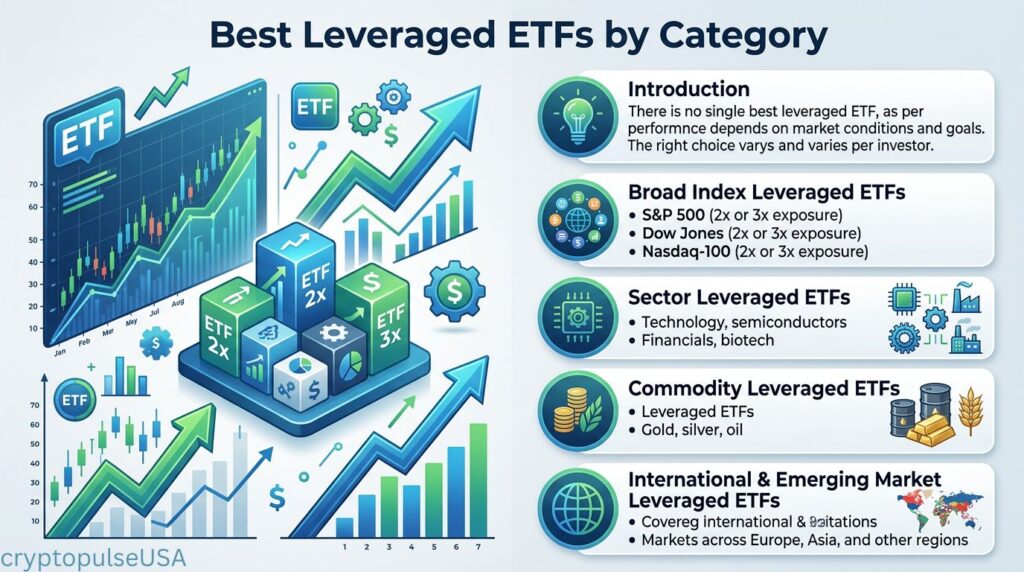
Broad Index Leveraged ETFs
These track major benchmarks like the S&P 500, Dow Jones, or Nasdaq-100 at 2x or 3x daily exposure. They’re popular for traders looking to express a short-term view on the overall market’s direction.
Sector Leveraged ETFs
Technology, semiconductors, financials, and biotech are among the most actively traded leveraged sector funds. These appeal to traders with strong conviction about a specific industry’s near-term momentum.
Commodity Leveraged ETFs
Gold, silver, and oil-linked leveraged funds let traders express views on commodity prices without directly trading futures contracts.
International & Emerging Market Leveraged ETFs
These provide amplified exposure to specific countries or regions, often used by traders reacting to geopolitical or macroeconomic events abroad.
Understanding the Inverse ETF Side
Not every trader wants to bet on markets going up. This is where an inverse ETF sometimes searched as google inverse etf when people are researching these products online comes into play. Inverse ETFs are built to move in the opposite direction of their underlying index. If the index falls 1% in a day, an inverse ETF targets a roughly 1% gain.
Some inverse funds also carry leverage, meaning a 2x or 3x inverse ETF could target -2% or -3% for every 1% decline in the benchmark. These products are commonly used for:
- Hedging an existing long portfolio during periods of expected volatility
- Short-term bearish speculation without shorting individual stocks
- Tactical positioning around earnings, economic data, or Fed announcements
As with leveraged long funds, inverse ETFs reset daily and are best suited to short holding periods rather than long-term bearish bets.
How Leverage ETFs Differ From Traditional ETFs
Traditional ETFs simply track an index’s performance one-to-one. Leverage ETFs, by contrast, use derivatives to create magnified and sometimes inverse exposure. A few structural differences worth knowing:
| Feature | Traditional ETF | Leveraged ETF |
|---|---|---|
| Daily reset | No | Yes |
| Typical holding period | Long-term | Short-term/tactical |
| Expense ratios | Generally lower | Generally higher |
| Volatility decay risk | Minimal | Significant over time |
| Use of derivatives | Rare | Core to strategy |
That expense ratio difference matters more than it might seem leveraged funds require active daily rebalancing, which adds management costs that traditional index funds don’t carry.
Key Risks to Understand Before Trading Leveraged ETFs
Before adding any fund from a leveraged ETF list to your account, keep these risks in mind:
- Compounding/volatility decay — In choppy, sideways markets, leveraged ETFs can lose value even if the underlying index ends up flat over time.
- Higher expense ratios — Management fees are typically higher than standard index ETFs.
- Amplified losses — Just as gains are magnified, so are losses, and quickly.
- Not designed for buy-and-hold — These are built for short-term tactical trades, not retirement accounts meant to be held for decades.
- Liquidity and tracking differences — Not all leveraged ETFs track their target multiple perfectly, especially during high-volatility periods.
Who Actually Uses Leveraged ETFs?
Leveraged ETFs tend to attract:
- Active/day traders looking for short-term amplified moves
- Swing traders holding positions for days rather than months
- Hedgers using inverse products to offset long portfolio risk
- Sophisticated investors making tactical, thesis-driven bets
They’re generally not recommended for beginner investors or anyone building a long-term, passive retirement portfolio, given the daily-reset mechanics and cost structure involved.
Final Thoughts
A well-researched leveraged ETF list can be a powerful tool for traders who understand exactly how these products behave but they reward precision and discipline far more than patience. Whether you’re eyeing a 2x ETF list for measured amplified exposure, exploring the best leveraged ETFs in a sector you follow closely, or considering an inverse ETF to hedge a downturn, the same rule applies: know the daily-reset mechanics, size positions carefully, and treat these as short-term tools rather than core long-term holdings.
Frequently Asked Questions
What is a leveraged ETF?
A leveraged ETF is a fund that uses derivatives like swaps and futures to amplify the daily returns of an underlying index, typically at 2x or 3x the daily performance.
What’s the difference between a 2x ETF and a 3x ETF?
A 2x ETF aims to double the daily return of its benchmark, while a 3x ETF aims to triple it. Higher leverage means higher potential gains and higher potential losses especially over multiple trading days.
Are leveraged ETFs good for long-term investing?
Generally, no. Because leveraged ETFs reset daily, their long-term performance can diverge significantly from a simple multiple of the underlying index, particularly in volatile or sideways markets. Most are designed for short-term or tactical trades.
What is an inverse ETF used for?
An inverse ETF is designed to move opposite to its underlying index, making it a common tool for hedging a long portfolio or speculating on short-term declines without shorting individual stocks.
Can leveraged ETFs go to zero?
While rare, sustained losses combined with daily compounding effects can severely erode a leveraged ETF’s value over time, especially during extended volatile periods. It’s uncommon for them to hit zero outright, but substantial value loss is a real risk.
How do I choose the best leveraged ETF for my strategy?
Consider the underlying index or sector, the leverage multiple (2x vs 3x), expense ratio, average daily trading volume, and most importantly your intended holding period. These funds work best when paired with a clear, short-term market thesis.
Do leveraged ETFs pay dividends?
Some do, depending on the underlying assets and fund structure, but dividend yields on leveraged ETFs are typically less significant than the price movements these funds are built to capture.
Is a leveraged ETF list the same as a list of inverse ETFs?
Not necessarily. A leveraged ETF list can include both long (bullish) and inverse (bearish) funds, some of which also carry leverage multiples like 2x or 3x. It’s worth checking each fund’s objective before investing.





Leave a Reply