
Learning how to make a crypto coin is no longer reserved for elite developers with years of blockchain experience. Thanks to open source tools, pre-built templates, and no-code platforms, anyone with a clear idea and a bit of patience can launch a crypto coin today. Whether you want to build a utility token for a project, experiment with a meme coin, or lay the groundwork for a full-fledged blockchain, this guide walks you through the entire process from concept to exchange listing.
Coin vs. Token: Know the Difference First
Before you start building, it’s important to understand a distinction that trips up almost every beginner.
- A coin operates on its own independent blockchain (like Bitcoin on the Bitcoin blockchain or Ether on Ethereum).
- A token is built on top of an existing blockchain using that chain’s standards (like an ERC-20 token on Ethereum or a BEP-20 token on BNB Smart Chain).
Building a coin means creating and maintaining your own blockchain a serious technical undertaking. Building a token is far more accessible, since you’re leveraging infrastructure that already exists and is already secure. Most beginners and even many funded startups start with a token and only consider building a dedicated blockchain once they have real usage and a reason to need one.
For the rest of this guide, we’ll cover both paths, but focus mainly on the token route since it’s where almost everyone should start.
Define Your Purpose and Use Case
Before writing a single line of code, get clear on why your coin needs to exist. Ask yourself:
- Is it a utility token (grants access to a product, service, or platform)?
- Is it a governance token (gives holders voting rights in a project)?
- Is it a meme coin (built for community and speculation rather than utility)?
- Is it a security token (represents an investment contract or ownership stake)?
This decision shapes everything downstream your legal obligations, your tokenomics, and even which blockchain makes sense for you.
Choose Your Blockchain
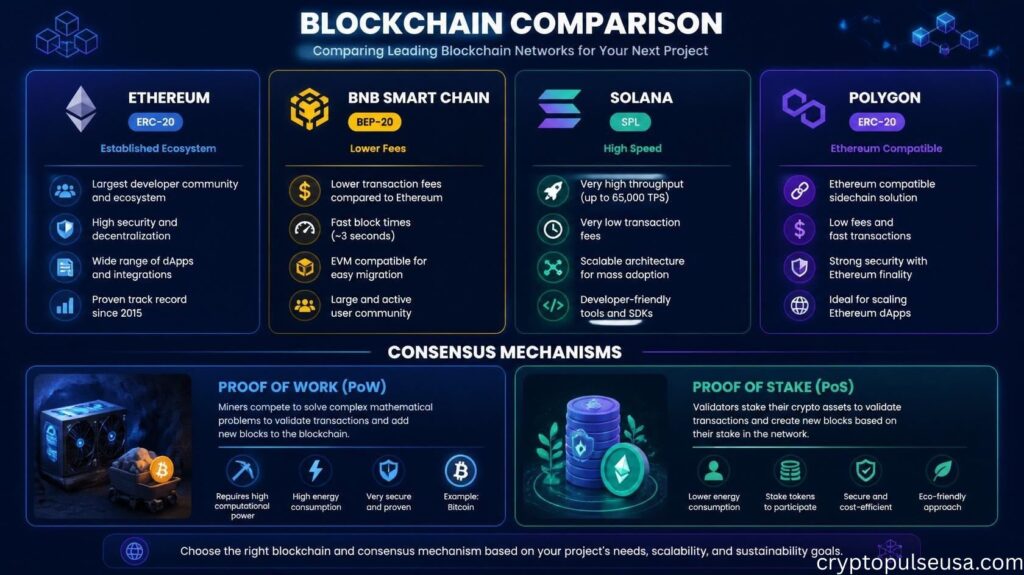
Your blockchain choice determines your development cost, transaction speed, fees, and the tools available to you. Common options include:
| Blockchain | Best For | Token Standard |
|---|---|---|
| Ethereum | Established ecosystem, high trust, DeFi integration | ERC-20 |
| BNB Smart Chain | Lower fees, faster transactions | BEP-20 |
| Solana | High speed, low cost, growing meme coin ecosystem | SPL |
| Polygon | Ethereum compatibility with lower fees | ERC-20 (Polygon) |
If you’re building a coin rather than a token, you’ll need to either fork an existing blockchain’s code (a common approach for new Layer 1 projects) or build one from scratch both require serious blockchain development expertise.
Decide on a Consensus Mechanism (If Building a Coin)
If you’re launching your own blockchain rather than a token, you’ll need to choose how your network validates transactions:
- Proof of Work (PoW): Miners solve computational puzzles to validate transactions. Secure but energy intensive (used by Bitcoin).
- Proof of Stake (PoS): Validators stake coins to earn the right to validate transactions. Faster and more energy-efficient (used by Ethereum since its 2022 upgrade).
Most new projects in 2026 choose PoS or a PoS variant due to lower energy costs and faster transaction finality.
Design Your Tokenomics
Tokenomics the economic design of your coin is often the single biggest factor in whether a project succeeds or fails. Key decisions include:
- Total supply: Fixed (like Bitcoin’s 21 million cap) or inflationary?
- Distribution: How much goes to the team, investors, community, and liquidity pools?
- Vesting schedules: Will team and investor tokens unlock gradually to prevent early dumping?
- Utility: What can holders actually do with the token?
- Burn mechanisms: Will tokens be periodically removed from circulation to manage supply?
Poorly planned tokenomics especially unlocking too many tokens to insiders too early is one of the most common reasons new coins lose community trust and crash shortly after launch.
Build the Smart Contract
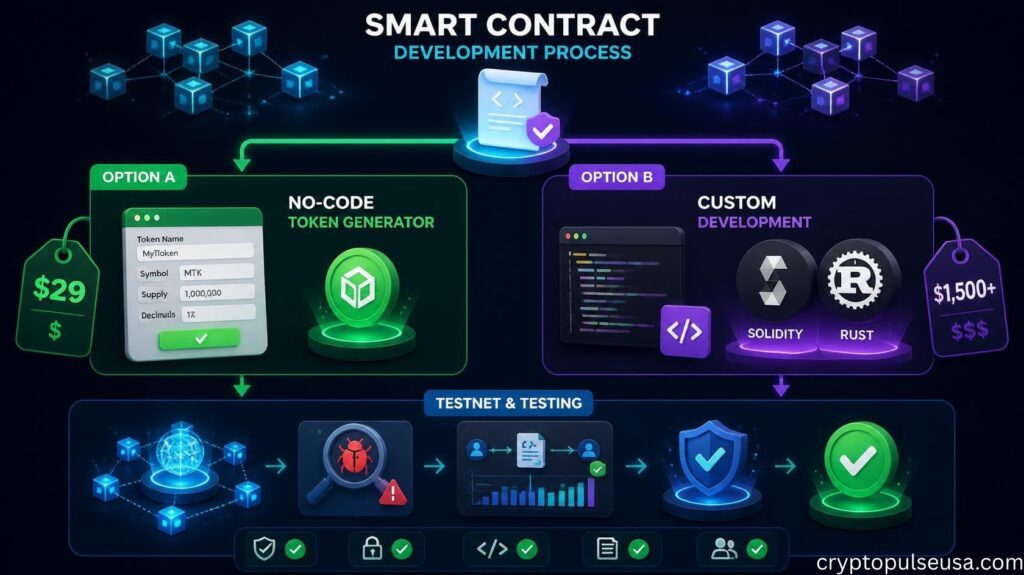
This is where your token comes to life. You have two main paths:
Option A: Use a no-code token generator Platforms exist that let you deploy a basic ERC-20 or BEP-20 token by filling out a form setting your name, symbol, supply, and a few parameters. This is the fastest and cheapest route, ideal for simple utility or meme coins.
Option B: Custom smart contract development If you need custom logic staking mechanics, deflationary burns, transaction taxes, or unique governance features you’ll need a developer to write and customize the smart contract, typically using Solidity (for Ethereum-based chains) or Rust (for Solana).
Cost varies widely based on complexity. Simple tokens using existing templates can be deployed for a few hundred dollars, while custom-built tokens with unique mechanics and full development support often run between $10,000 and $15,000, depending on your requirements and the developers you hire.
Test on a Testnet
Never deploy directly to the main blockchain without testing first. Every major blockchain has a free “testnet” a parallel environment using fake tokens where you can:
- Confirm your smart contract behaves as intended
- Check for bugs in minting, transfers, and burning
- Simulate real-world usage before real money is involved
Skipping this step is one of the most common (and costly) mistakes new projects make.
Get a Security Audit
Before launching publicly, have your smart contract reviewed by a third-party security auditing firm. Audits catch vulnerabilities like reentrancy attacks, integer overflow bugs, or backdoor functions that could let bad actors drain funds. This step alone has saved countless projects from catastrophic hacks and its absence has sunk just as many. Depending on scope,a security audit typically takes around four to eight weeks to complete.
Skipping an audit to save money is one of the riskiest shortcuts in crypto development exploited contracts can destroy investor trust overnight.
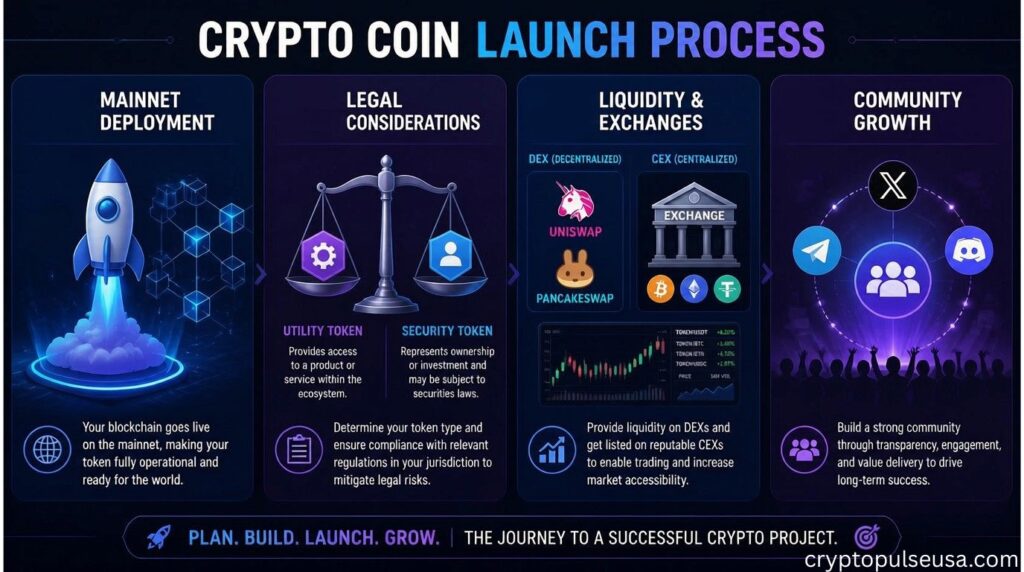
Deploy to Mainnet
Once testing and auditing are complete, you deploy your smart contract to the blockchain’s live network (the “mainnet”). At this point, your coin officially exists on-chain and transactions become real and irreversible.
Understand U.S. Legal and Regulatory Considerations
If you’re targeting the U.S. market, regulatory classification matters enormously. Broadly speaking:
- Utility tokens face lighter regulatory scrutiny if they genuinely provide access to a product or service rather than functioning as an investment.
- Security tokens are subject to full securities law, including registration requirements, if they represent an investment contract or ownership stake.
Getting this classification wrong can expose you to serious legal risk. It’s worth consulting a lawyer familiar with digital asset regulation before your public launch especially if you’re raising funds from U.S. investors.
Build Liquidity and List on Exchanges
A coin with no liquidity is a coin nobody can trade. Common approaches include:
- Decentralized exchange (DEX) listing: Create a liquidity pool on platforms like Uniswap or PancakeSwap by pairing your token with an established coin (like ETH or BNB).
- Centralized exchange (CEX) listing: Larger exchanges often require an application process, listing fees, and a track record of trading volume and community activity before accepting a new coin.
Most new projects start on a DEX, since listing is permissionless and immediate, then work toward CEX listings as trading volume and community trust grow.
Market and Grow Your Community
Technology alone doesn’t make a coin succeed community does. Effective early strategies include:
- Building an active presence on X (Twitter), Telegram, and Discord
- Publishing transparent, regular project updates
- Partnering with other projects or influencers in your niche
- Running a clear, honest roadmap that you actually follow
Overpromising and underdelivering is the fastest way to lose community trust in crypto a space where reputations spread (and collapse) quickly.
How Much Does It Cost to Create a Crypto Coin?
Costs vary enormously based on complexity:
- No-code token on an existing blockchain: A few hundred to a couple thousand dollars
- Custom token with unique smart contract logic: Roughly $10,000–$15,000
- Fully custom blockchain (a true “coin,” not a token): Tens of thousands of dollars and up, depending on team size and complexity
On top of development, budget for auditing, legal consultation, marketing, and liquidity provisioning these often add up to more than the core development cost itself.
Common Mistakes to Avoid
- Skipping the audit to save time or money
- Overconcentrating supply among the team or early investors
- Launching without a clear use case beyond speculation
- Ignoring legal classification in your target markets
- Underestimating liquidity needs, leading to extreme price volatility
- No marketing plan, resulting in a coin nobody knows exists
Final Thoughts
Making a crypto coin has become far more accessible than it was even a few years ago, but “accessible” doesn’t mean “risk-free.” The technical side choosing a blockchain, writing a smart contract, testing, and auditing is only half the job. The other half is tokenomics, legal compliance, and community building, and skipping any of these is where most new coins fail.
If you’re serious about launching a coin, start small: deploy a simple token on a testnet, learn how the mechanics work, and only move to mainnet once you’re confident in your contract’s security and your project’s long-term plan.
FAQ
How much does it cost to make a crypto coin?
Costs range from a few hundred dollars for a simple no-code token to $10,000–$15,000+ for a custom smart contract with unique features. Full custom blockchains (true “coins”) can cost tens of thousands of dollars depending on complexity and team size
Can I create a cryptocurrency for free?
You can deploy a basic token using free open-source templates and testnets at no cost, but a real public launch still requires expenses for gas fees, security audits, and liquidity so “fully free” is rare once you go live.
Do I need to know how to code to make a crypto coin?
No. No-code token generators let you deploy a basic ERC-20 or BEP-20 token without programming knowledge. However, custom features like staking, burns, or unique tokenomics typically require a developer skilled in Solidity or Rust.
What’s the difference between a coin and a token?
A coin runs on its own independent blockchain (like Bitcoin), while a token is built on top of an existing blockchain using that chain’s standards (like an ERC-20 token on Ethereum). Tokens are far easier and cheaper to create.
How long does it take to create a crypto coin?
A simple token can be deployed in a day or two. A custom token with a security audit typically takes four to eight weeks. A fully custom blockchain can take several months to over a year, depending on scope.
Do I need a security audit before launching my coin?
Yes. Audits catch vulnerabilities like reentrancy attacks or backdoor functions before real money is involved. Skipping this step is one of the most common and costly mistakes new projects make, often leading to exploits after launch.
How do I get my new coin listed on an exchange?
Most new coins start with a decentralized exchange (DEX) listing by creating a liquidity pool (e.g., on Uniswap or PancakeSwap). Centralized exchange (CEX) listings usually require an application, fees, and proven trading volume first.







Leave a Reply