
If you’ve been researching cryptocurrency, you’ve probably come across Ripple (XRP). Unlike Bitcoin or Ethereum, XRP was created with a specific goal: making international payments faster, cheaper, and more efficient.
Many beginners are confused because they hear the terms Ripple, XRP, and XRP Ledger used interchangeably. On top of that, legal discussions in the United States have made XRP one of the most talked about digital assets in the crypto industry.
Whether you’re considering buying XRP or simply want to understand its role in blockchain technology, this guide will help you build a solid foundation.
Quick Facts About XRP
| Feature | Details |
|---|---|
| Cryptocurrency | XRP |
| Company Behind Development | Ripple |
| Blockchain | XRP Ledger (XRPL) |
| Launch Year | 2012 |
| Consensus Method | XRP Ledger Consensus Protocol |
| Average Transaction Time | 3–5 seconds |
| Typical Transaction Fee | A fraction of a cent |
| Main Purpose | Fast, low-cost cross-border payments |
What Is Ripple (XRP)?
Ripple (XRP) is a digital payment ecosystem designed to improve how money moves around the world. While many cryptocurrencies focus on decentralized finance or smart contracts, XRP was created primarily to solve the challenges of international payments.
Traditional international bank transfers often involve multiple financial institutions, currency conversions, and settlement delays. These processes can take several days and incur significant fees.
XRP addresses these issues by enabling near-instant value transfers through the XRP Ledger, a decentralized blockchain built for speed and efficiency.
Although many people refer to XRP as “Ripple,” it’s important to understand that they are not the same thing. Ripple is the technology company that develops payment solutions, while XRP is the digital asset that can be used within that ecosystem.
Key Characteristics of XRP
- Fast settlement in just a few seconds
- Low transaction costs
- Energy-efficient consensus mechanism
- Designed for global payments
- Supports cross-border liquidity
- Accessible through many cryptocurrency exchanges
These features have made XRP one of the most recognized cryptocurrencies in the digital asset market.
The History of Ripple and XRP
Understanding XRP’s history provides valuable context for why it was created and how it differs from many other cryptocurrencies.
Ripple’s origins date back to the early 2010s, when developers sought to modernize international payment infrastructure. Instead of replacing banks entirely, the vision was to help financial institutions transfer money more efficiently using blockchain technology.
In 2012, the XRP Ledger was introduced, along with the XRP digital asset. Around the same time, Ripple began developing software solutions for banks, payment providers, and financial institutions.
Over the years, Ripple has partnered with numerous financial organizations to explore faster settlement systems. While not every partner uses XRP directly, Ripple’s payment technology has significantly influenced discussions about modernizing global finance.
XRP has also experienced substantial price fluctuations during cryptocurrency market cycles, attracting both long-term investors and short-term traders. Despite market volatility, XRP remains among the most established digital assets by market presence.
Why Was XRP Created?
To appreciate XRP’s purpose, consider how international money transfers typically work.
Imagine someone in New York wants to send money to a family member in another country. The transaction often passes through multiple banks before reaching its destination.
This traditional process can involve:
- Several intermediary banks
- High transfer fees
- Currency conversion costs
- Settlement delays of several business days
XRP was designed to reduce these inefficiencies.
Instead of relying on multiple intermediaries, XRP can act as a bridge asset between different currencies, allowing funds to move quickly across borders.
The intended benefits include:
- Faster settlements
- Lower transaction costs
- Improved liquidity
- Reduced operational complexity
This makes XRP particularly relevant for international payment networks.
How Does XRP Work?
One of XRP’s biggest strengths is its simplicity from the user’s perspective.
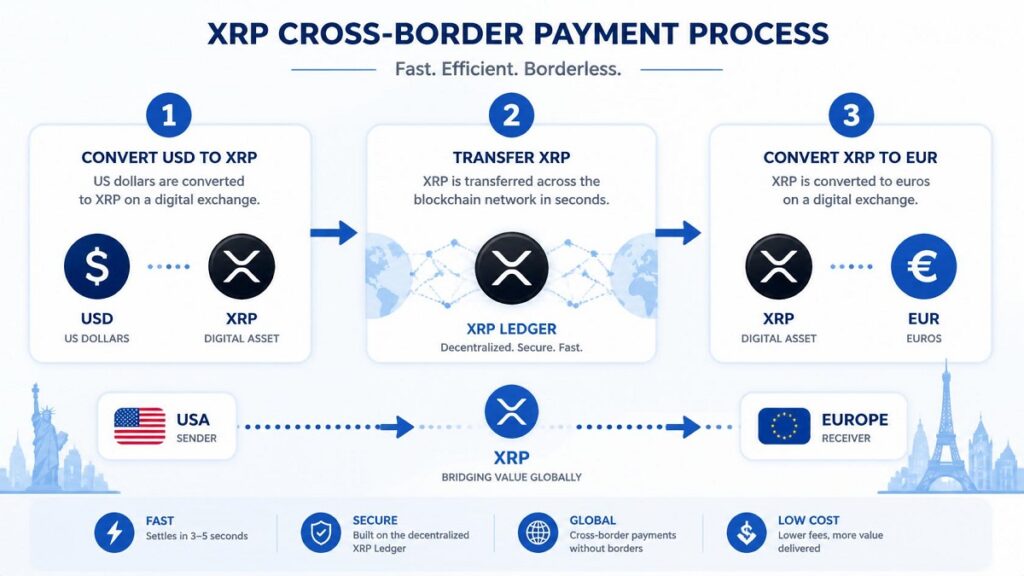
Imagine a financial institution in the United States needs to send funds to a recipient in Europe.
Rather than waiting for several correspondent banks to process the transfer, the institution can:
- Convert U.S. dollars into XRP.
- Send XRP across the XRP Ledger.
- Convert XRP into euros at the destination.
The transfer is typically completed within seconds rather than days.
Because the XRP Ledger processes transactions rapidly, both sending and receiving institutions can access funds much sooner than through many traditional systems.
This streamlined process is one reason XRP has become closely associated with cross-border payments.
Example: Sending Money Internationally
Here’s a simplified comparison:
Traditional Bank Transfer
- Bank A initiates the transfer.
- One or more intermediary banks process the payment.
- Currency conversion occurs.
- The receiving bank credits the funds.
Typical completion time: 1–5 business days.
XRP Transfer
- USD is converted to XRP.
- XRP is transferred on the XRP Ledger.
- XRP is converted into the recipient’s local currency.
Typical completion time: 3–5 seconds.
While actual workflows depend on the institutions involved, this example highlights why blockchain-based settlement systems have attracted interest.
Why Is XRP Faster Than Many Other Cryptocurrencies?
Several design choices contribute to XRP’s speed.
Unlike Bitcoin, which relies on mining, XRP transactions are confirmed through a consensus protocol on the XRP Ledger. This approach avoids the computational intensity associated with proof-of-work mining.
As a result, the network can:
- Process transactions quickly
- Keep fees very low
- Consume significantly less energy
- Support a high volume of payments
These characteristics make XRP well suited for payment-focused applications.
Main Features of XRP
Fast Transactions
Most XRP transfers settle within a few seconds, making the network suitable for time-sensitive payments.
Low Fees
Transaction fees on the XRP Ledger are typically a tiny fraction of a cent, allowing users to transfer value without high costs.
Energy Efficiency
Because XRP does not rely on mining, it requires substantially less energy than proof-of-work blockchains.
Global Accessibility
XRP is available on many cryptocurrency exchanges and can be accessed by users in numerous countries, subject to local regulations.
Scalable Network
The XRP Ledger is designed to handle a large number of transactions efficiently, supporting enterprise-level payment use cases.
Why Is XRP Different from Bitcoin?
Although both are cryptocurrencies, they were created for different purposes.
| Bitcoin | XRP |
|---|---|
| Designed as a decentralized digital currency and store of value | Designed for fast payments and liquidity |
| Uses Proof of Work mining | Uses a consensus protocol |
| Block confirmation typically takes around 10 minutes | Transactions usually settle in seconds |
| Higher transaction fees during network congestion | Generally very low transaction fees |
| Often viewed as “digital gold” | Primarily focused on payment infrastructure |
These differences mean Bitcoin and XRP serve different roles within the broader cryptocurrency ecosystem.
Final Thoughts: Understanding Ripple (XRP) Before Investing
Ripple (XRP) is one of the most recognized cryptocurrencies because it focuses on solving a real-world problem: making global payments faster, cheaper, and more efficient.
Unlike Bitcoin, which is mainly viewed as a digital store of value, XRP was designed as a payment-focused digital asset that can help improve cross-border transactions. Its fast settlement speed, low fees, and energy-efficient technology have made it an important project in the blockchain industry.
However, understanding XRP requires looking beyond hype and price predictions. Like every cryptocurrency, XRP comes with risks, including market volatility, regulatory changes, competition, and uncertainty around future adoption.
For beginners in the United States, the most important steps are:
- Learn how XRP and the XRP Ledger work before investing
- Understand the difference between Ripple, XRP, and XRPL
- Research regulations and trusted platforms
- Never invest more than you can afford to lose
- Focus on long-term knowledge rather than short-term price movements
XRP has a unique position in the cryptocurrency market because it combines blockchain technology with a practical financial use case. Whether it becomes a major part of global payment infrastructure depends on future adoption, regulations, and continued development.
The best approach for beginners is simple: understand first, invest carefully, and manage risk responsibly.
FAQ
What is XRP cryptocurrency?
XRP is a digital asset created to enable fast and low-cost transactions, especially for cross-border payments. It operates on the XRP Ledger, a blockchain network designed for speed and efficiency.
Is Ripple the same as XRP?
No, Ripple and XRP are different.
Ripple is a technology company that develops blockchain-based payment solutions.
XRP is the cryptocurrency that operates on the XRP Ledger.
A simple way to remember:
Ripple = Company
XRP = Digital asset
XRP Ledger = Blockchain network
How does XRP work?
XRP works by allowing value to move quickly between different currencies. Instead of relying on multiple banking intermediaries, XRP can act as a bridge asset that helps transfer money internationally within seconds.
What is XRP used for?
XRP is mainly used for:
Cross-border payments
Currency exchange liquidity
Faster financial settlements
Blockchain-based payment solutions
Its primary purpose is improving the efficiency of global money transfers.
Is XRP legal in the United States?
Yes, XRP is available for trading in the United States. However, cryptocurrency regulations continue to evolve, and investors should stay updated on current laws and exchange policies.
How fast are XRP transactions?
XRP transactions are typically confirmed within a few seconds. The XRP Ledger is designed for fast settlement compared with many traditional payment systems.
Is XRP better than Bitcoin?
XRP and Bitcoin were created for different purposes.
Bitcoin is mainly considered a decentralized store of value, while XRP focuses on fast payments and financial settlement.
Neither is universally “better”; they serve different roles in the cryptocurrency ecosystem
Can beginners buy XRP?
Yes, beginners can purchase XRP through many cryptocurrency exchanges that support XRP trading. However, beginners should understand crypto risks before investing.
Is XRP a good investment?
Whether XRP is a good investment depends on individual goals, risk tolerance, and market conditions.
Potential advantages:
Fast transactions
Real-world payment use case
Established blockchain network
Potential risks:
Price volatility
Regulatory uncertainty
Competition from other payment technologies
Always research before making investment decisions.
Where can I buy XRP in the USA?
US users can buy XRP through supported cryptocurrency exchanges. Before choosing an exchange, consider:
Security features
Fees
Regulatory compliance
Available payment methods



Leave a Reply