
Wondering how to make a meme coin of your own? The good news is that launching one no longer requires deep coding knowledge thanks to no-code token creators, most of the technical heavy lifting is handled for you. The harder part, and the part that actually determines whether your coin survives past launch day, is everything around the token: your concept, your tokenomics, your legal footing, and how you build a community willing to trade it.
This guide walks through the full process, from picking a blockchain to getting your coin listed and trading. If you’re deciding between a meme coin and a more general-purpose token, our guide on How to Make a Crypto Coin breaks down that broader decision in more detail.
Why Create a Meme Coin?
Meme coins are typically built around a joke, a cultural reference, or a community identity rather than a specific technical use case but that doesn’t mean they’re all just novelty projects. Depending on your goals, a meme coin can be used to:
- Build and reward an online community
- Raise funds for a shared cause or creative project
- Experiment with tokenized rewards, access, or perks tied to a brand or persona
- Simply test the waters of crypto development on a low-cost chain
Be honest with yourself about the goal before you start. A coin built purely to chase a quick pump behaves very differently and carries different risks and responsibilities than one built to genuinely serve a community over time.
Define Your Concept and Theme
Every successful meme coin starts with a clear, relatable idea. Ask yourself:
- What cultural reference, meme, animal, or in-joke is the coin built around?
- Who is the target audience, and where do they already spend time online (Telegram, X, Discord, Reddit)?
- Will the coin be purely for fun and community engagement, or will it have some added utility, like access to perks, governance, or rewards?
Dogecoin is the classic example it began purely as a joke based on the “Doge” meme, but its strong, loyal community turned it into one of the most recognized cryptocurrencies in the world. Shiba Inu took a different route, layering in its own ecosystem and utility features to differentiate itself from Dogecoin. Your theme doesn’t need to be original in a technical sense, but it does need to be catchy, memorable, and distinct enough to stand out in a crowded market.
Choose Your Blockchain
Your blockchain choice affects cost, speed, tooling, and where your community is most likely to find you.
| Blockchain | Why Creators Choose It |
|---|---|
| Solana | The fastest and cheapest option, with the most active meme coin trading volume and launch activity right now |
| Ethereum | Large user base, strong security, and the most mature smart contract tooling |
| BNB Smart Chain (BSC) | Low fees and beginner-friendly tools |
| Base / other EVM chains | Growing ecosystems with lower fees than Ethereum mainnet, while keeping EVM compatibility |
| Sui | An emerging option with simple, no-code token creation tools |
If speed, low fees, and an active meme focused trading community matter most to you, Solana is currently the most common starting point. If you want deeper DeFi integrations or a more established developer ecosystem, an EVM chain may suit you better.
Set Your Tokenomics
Tokenomics how your coin’s supply and distribution work shapes both trust and long-term sustainability. Key decisions include:
- Total supply. A round number in the billions (1 billion is a common cultural default for meme coins) is standard, though it’s ultimately arbitrary and only matters relative to your circulating price.
- Decimals. Solana tokens commonly use 9 decimals; EVM tokens typically use 18.
- Distribution. Decide what percentage goes to liquidity, the team, community incentives, and any presale, and be transparent about this split vague or hidden allocations are one of the fastest ways to lose community trust.
- Mint authority. Decide whether your token supply is fixed forever or whether you’ll retain the ability to mint more later. A fixed supply (revoking mint authority after launch) tends to build more investor confidence.
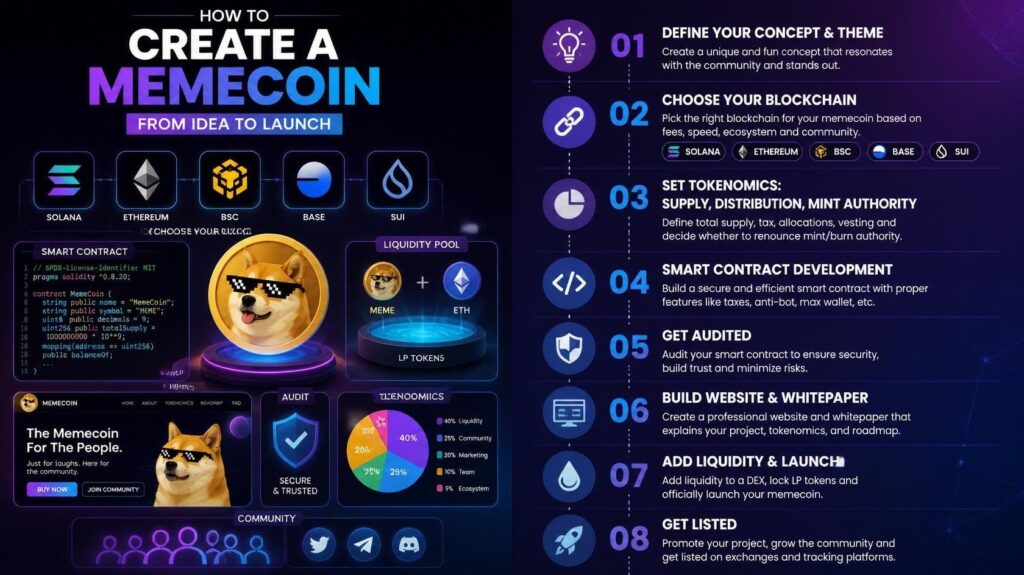
Build the Smart Contract (or Use a No-Code Tool)
You have two main paths here:
- No-code token creators. Platforms exist for Solana, EVM chains, and Sui that let you connect a wallet, set your name, ticker, and supply, and deploy a token in minutes without writing code.
- Custom smart contract development. For more advanced features (custom transfer taxes, burn mechanisms, staking, etc.), you’ll need a developer familiar with your chosen chain’s standard (SPL on Solana, ERC-20 on Ethereum, BEP-20 on BSC).
Whichever path you choose, test thoroughly on a testnet before deploying to mainnet, where mistakes can be costly and difficult to reverse.
Get a Smart Contract Audit
Before you launch publicly, have your contract reviewed by a reputable third-party auditor (well-known names in this space include CertiK and Hacken). An audit helps catch vulnerabilities before they become expensive exploits, and it gives potential holders a credible reason to trust your project rather than just your marketing.
Build a Website and Whitepaper
A basic website and a short whitepaper go a long way toward establishing legitimacy. At minimum, include:
- A homepage explaining your coin’s concept and purpose
- An “About” page introducing the team (or explaining why the team is anonymous, if that’s the case)
- A tokenomics breakdown
- A roadmap outlining what comes next
- Links to your social channels and community spaces
Transparency here matters more than polish. A clear, honest whitepaper builds more trust than an overproduced one that’s vague on the details.
Handle Legal and Compliance Basics
Meme coin regulation varies by country and continues to evolve. Before launch:
- Consult a crypto-familiar legal advisor about your specific jurisdiction and target markets.
- Understand basic AML (anti-money laundering) expectations if you’re accepting funds.
- Post clear disclaimers on your site making clear the coin carries no guaranteed value or return.
Skipping this step doesn’t just carry legal risk it can also block you from listing on more reputable exchanges later.
Add Liquidity and Launch
Without liquidity, no one can actually buy or sell your token. This typically means pairing your coin with an established asset (like SOL, ETH, or USDC) in a liquidity pool on a decentralized exchange such as Raydium (Solana), Uniswap (Ethereum), or PancakeSwap (BNB Chain).
A few practical notes:
- Lock your liquidity. Locking (rather than retaining full control of) your liquidity pool for a set period is one of the clearest signals to a community that you don’t intend to “rug” the project.
- Start with a realistic price and supply split rather than an inflated valuation that’s hard to sustain.
Once your coin has liquidity and is trading, your focus shifts from creation to trading dynamics and that’s a very different skill set. Our guide on How to Trade Memecoins Safely in a Volatile Market covers stop-loss strategy and risk management for anyone trading (or holding) a coin post-launch.
Get Listed and Build Visibility
To reach more traders, most projects aim to:
- Get listed on additional decentralized exchanges as volume grows
- Pursue listings on centralized exchanges once the project has traction and (often) a completed audit
- Work with micro-influencers and community members for organic, grassroots visibility rather than one large promotional push
If you’re choosing where to trade or list your coin, our breakdown of Best Exchanges for Trading Memecoins compares the top platforms by liquidity, fees, and risk-management tools.
Common Mistakes to Avoid
- Skipping the audit to launch faster this is one of the most common causes of exploited or abandoned projects.
- Hiding tokenomics or team allocation instead of disclosing it upfront.
- Not locking liquidity, which understandably makes traders suspicious of a rug pull.
- Copying an existing coin’s branding too closely, which can create legal issues and community backlash.
- Treating marketing as an afterthought. A meme coin’s brand and community energy often matter more to its short-term trajectory than its technical features.
FAQ
Do I need to know how to code to make a meme coin?
No. No-code token creators exist for Solana, Ethereum, BNB Chain, and other networks that let you deploy a basic token by connecting a wallet and filling in a few fields. Coding knowledge becomes more important if you want custom contract features beyond a standard token.
How much does it cost to launch a meme coin?
Deployment costs vary by chain Solana deployment fees are typically under a dollar, while Ethereum gas fees can run considerably higher. Beyond deployment, budget for an audit, liquidity provisioning, and any marketing or influencer outreach.
Which blockchain is best for a meme coin?
Solana is currently the most common choice for new meme coins because of its low fees, fast transactions, and large existing meme-trading community. Ethereum and other EVM chains remain popular for projects prioritizing DeFi tooling or a specific existing ecosystem.
Is making a meme coin legal?
Creating a token itself is generally legal in most jurisdictions, but how you market it, whether you conduct a public sale, and how you handle investor funds can trigger securities or AML regulations depending on your country. Consult a legal advisor familiar with crypto regulation in your target markets before launching.
How do I make my meme coin tradable?
You need to add liquidity — pairing your token with an established asset like SOL, ETH, or USDC in a liquidity pool on a decentralized exchange. From there, growing volume and community interest can lead to additional DEX or centralized exchange listings over time.
Conclusion
Learning how to make a meme coin is only step one the technical deployment is often the easiest part of the whole process. The projects that last are the ones built on a clear concept, transparent tokenomics, a completed audit, proper legal groundwork, and a genuine community rather than a one-time hype push.
This article is for informational purposes only and isn’t financial, legal, or investment advice. Creating and launching a token carries real financial, legal, and reputational risk. Consider speaking with qualified legal and financial professionals before launching a project of your own.



Leave a Reply