
Memecoins Are Back in the Spotlight
Memecoins never really went away they just took a breather. After a quieter 2025, coins like Dogecoin, Shiba Inu, Pepe, Bonk, and dogwifhat (WIF) have roared back into view, with the category’s total market capitalization swinging into the tens of billions of dollars as fresh capital rotates back into higher-risk crypto assets. If you want to trade memecoins safely in this environment, the platform and process you choose matter just as much as the coin you pick. Solana-based tokens in particular have become a major focal point of this cycle, thanks to the network’s low fees and fast settlement times.
None of that means memecoins are any less risky. The same volatility that can hand a trader a huge win can just as easily wipe out an account overnight. The difference between traders who survive multiple cycles and those who blow up their portfolios usually comes down to platform choice, risk controls, and discipline not luck.
Understanding Memecoins in Today’s Market
What Are Memecoins?
Memecoins are cryptocurrency tokens that originate from internet culture often as jokes or community in jokes rather than from a specific technical use case. Despite their playful origins, several have grown into assets with multi billion dollar market capitalizations, deep liquidity, and active trading communities on major exchanges.
Why They’re Still Popular in 2026
- Community-driven momentum. Memecoins live and die by online communities on platforms like Telegram, Discord, and X. Sentiment shifts fast, and so do prices.
- Low barrier to entry. Most memecoins trade for fractions of a cent, making them accessible to traders with small amounts of capital.
- High volatility, high attention. Big percentage swings attract short-term traders looking for momentum, though the same volatility magnifies losses.
- A more “mature” narrative. Traders increasingly talk about “narrative durability” how long a coin’s story can hold community attention as a key factor separating short-lived pumps from coins with staying power.
- Utility experiments. Some established names, like Shiba Inu, have leaned into layer 2 infrastructure and burn mechanisms to shift from pure speculation toward something closer to an established, if still volatile, asset.
That said, the underlying risk hasn’t changed: a large share of memecoin traders still lose money, and only a small percentage of wallets ever see significant profit. Treat any memecoin position as high risk speculation, not an investment you can’t afford to lose.
How to Trade Memecoins Safely (Even in a Falling Market)
Trading memecoins successfully isn’t about calling every top and bottom it’s about consistent risk control.
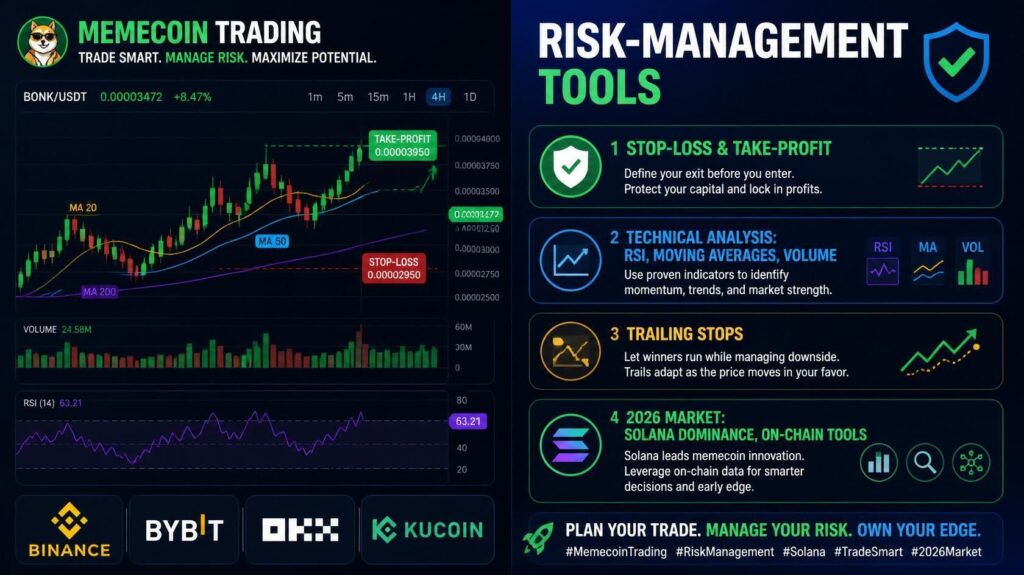
1. Choose an Exchange With Real Risk Management Tools
Not all platforms offer the same order types, and in a fast-moving memecoin market, having access to stop-loss and take-profit orders isn’t optional.
| Platform | Notable For | Stop-Loss / Risk Tools |
|---|---|---|
| Binance | Deepest liquidity, widest memecoin selection | Stop-loss, OCO, take-profit |
| Bybit | Strong futures/margin tools, copy trading | Yes |
| OKX | Dual “Simple” and “Exchange” modes, advanced charting | Stop-loss, take-profit, trailing stop |
| KuCoin | Early listings of newer/low-cap tokens | Yes |
| Phemex | Meme-focused discovery tools, spot + futures + bots | Yes |
| Decentralized exchanges (Uniswap v4, Raydium) | On-chain access to unlisted or brand-new tokens | Increasingly available via smart-contract “hooks,” though features vary by pool |
A few practical notes:
- Centralized exchanges generally offer the most reliable stop-loss and take-profit tools, plus easier fiat on-ramps.
- Decentralized platforms give you earlier access to brand-new tokens, but on chain risk tools are newer and less standardized verify how a specific pool or contract works before relying on it.
- Whichever platform you choose, check that it supports two factor authentication, cold storage, and (ideally) proof-of-reserves.
2. Set Clear Stop Loss and Take Profit Levels before You Enter
Decide your exit points before you place a trade, not after the coin starts moving. For example, if you enter a position at a given price, define in advance:
- The price at which you’ll cut losses if the trade goes against you
- The price at which you’ll take profit if the trade works out
- What percentage of your position (if any) you’ll scale out at each level
Writing these numbers down or setting them directly as automated orders removes emotion from the decision.
3. Use Basic Technical Analysis
- RSI (Relative Strength Index): Helps flag overbought or oversold conditions.
- Moving averages: Useful for spotting the general direction of a trend.
- Volume: A price move on weak volume is far less reliable than one backed by strong trading activity a useful way to separate genuine momentum from thin, easily reversed pumps.
Technical analysis won’t predict the future, but it gives you a more objective read on momentum than gut feeling alone.
4. Use Trailing Stops and Avoid Emotional Trading
- Trailing stops move automatically as a coin’s price rises, locking in gains without requiring you to watch charts constantly.
- Let your risk system do its job. Overriding a stop loss “because you have a feeling” is one of the most common ways traders turn a small loss into a large one.
- Diversify. Avoid concentrating your entire position in a single token, no matter how confident you feel.
2026 Memecoin Market Snapshot
A few themes have defined the memecoin space so far this year:
- Renewed capital inflows. After a subdued 2025, memecoins saw a sharp early-2026 rebound as speculative capital rotated back into higher-risk crypto sectors.
- Solana’s continued dominance. Solana remains a hub for new memecoin launches and trading activity, thanks to low fees and fast transaction times.
- Divergent paths for established coins. Some long-standing tokens, like Shiba Inu, have settled into relatively lower volatility as their ecosystems (e.g., layer-2 networks, burn mechanisms) mature, while newer tokens continue to see sharp, short-lived pumps.
- On-chain trading tools maturing. Newer smart-contract features on platforms like Uniswap are starting to bring exchange-style order types (like automated stop losses) directly on chain, though this is still an evolving and technically complex space.
Because conditions shift quickly, treat any specific price levels you read online including in this guide as illustrative examples rather than current, actionable numbers. Always check live charts before trading.
Strategies Traders Use to Navigate Memecoin Volatility
Early trend identification. Some traders use on-chain scanning and DEX-tracking tools to spot new listings and rising volume before a token gains wider attention. This approach carries elevated risk, since new tokens are more likely to be illiquid or outright scams.
Short-term scalping. Others focus on capturing small, frequent price swings (often in the 1–5% range) rather than holding through a coin’s full volatility cycle. This requires active monitoring and tight risk controls, since transaction costs and slippage can quickly erode small gains.
Liquidity provision and yield. Rather than only speculating on price, some traders provide liquidity on decentralized exchanges to earn trading fees. This comes with its own risks, including impermanent loss and smart-contract risk, and isn’t a way to avoid memecoin volatility just a different way of being exposed to it.
Diversifying across a basket of tokens rather than concentrating capital in a single memecoin is one of the more consistently cited risk-management practices among experienced traders.
Case Study: Pepe (PEPE) and the 2023 Meme Cycle
Pepe became one of the defining tokens of the 2023 memecoin wave, and it illustrates both the upside and the risk of this category well. Traders who entered early, during the initial surge in community attention, and who used stop-losses and staged profit-taking at resistance levels, were positioned very differently from those who bought in near the top of the hype cycle and held through the subsequent pullback.
The broader lesson isn’t “buy early and get rich” it’s that entry timing, exit discipline, and risk management explain most of the difference between memecoin traders who come out ahead and those who don’t. Pepe remains an actively traded token in 2026, but past performance in one cycle says little about how any specific token will perform going forward.
Regulatory Landscape: What’s Changing in 2026
Regulation of memecoins is still evolving and varies significantly by country and by exchange. In the U.S., regulators including the SEC and CFTC have continued to clarify their stance on how meme tokens are treated, which has implications for which coins get listed on major regulated exchanges and how they can be marketed. Rules differ elsewhere, and platforms may restrict certain tokens or features depending on where you’re located.
Practical takeaway: check what’s actually permitted on your platform and in your jurisdiction before trading, and don’t assume regulatory treatment is settled — it’s an area worth checking again periodically rather than a one-time lookup.
Using Stop-Loss Tools Like a Pro
Many traders lose money not because they picked the “wrong” coin, but because they never automated their risk controls in the first place. A few habits worth building:
- Use trailing stops so profitable positions can run while still protecting gains.
- Set stop-losses at the time you enter a trade, not after the price starts moving against you.
- Avoid “all-in” bets on a single token position sizing matters as much as coin selection.
- Review your risk rules periodically, especially as your account size or the broader market changes.
Frequently Asked Questions
Is it still possible to make money trading memecoins in 2026?
Yes, but it’s speculative by nature. Traders who do well tend to rely on disciplined entries and exits, position sizing, and stop-loss automation rather than picking a “sure thing.” Most memecoin wallets don’t end up meaningfully profitable, so treat any gains as a possibility, not an expectation.
What’s the safest exchange for trading memecoins?
There’s no single “safest” answer it depends on your priorities. Centralized exchanges like Binance, OKX, and Bybit tend to offer the most reliable stop-loss and take-profit tools plus stronger custody and compliance standards. Decentralized platforms like Uniswap or Raydium give earlier access to new tokens but come with more technical risk and less standardized risk tools.
How do I set a good stop-loss for a memecoin?
Decide your exit price before you enter the trade, based on a level you’re actually willing to lose, not an arbitrary percentage. Many traders also use trailing stops so the stop price moves up automatically as the coin gains, locking in profit without needing to watch the chart constantly.
Are memecoins riskier than other cryptocurrencies?
Generally, yes. Memecoins usually lack the underlying technology or use case that gives other crypto assets a fundamental value anchor, so their prices move heavily on sentiment, hype cycles, and liquidity which tends to make swings sharper in both directions.
What’s the difference between trading memecoins on a centralized exchange vs. a DEX?
Centralized exchanges (Binance, OKX, Bybit, etc.) offer easier fiat access, deeper liquidity for established tokens, and more mature order types. Decentralized exchanges give you access to brand-new tokens the moment they launch, but you’re responsible for your own wallet security, and on-chain risk-management tools (like smart-contract-based stop-losses) are newer and less consistent across platforms.
Do regulations affect which memecoins I can trade?
Yes. Regulatory treatment of memecoins varies by country, and U.S. regulators (the SEC and CFTC) have continued refining their stance on how these tokens are classified. This can affect which coins are listed on major regulated exchanges and how they’re marketed, so it’s worth checking your exchange’s current listings and your local rules rather than assuming they’re static.
How much of my portfolio should go into memecoins?
There’s no universal number, but most experienced traders treat memecoins as a small, high-risk allocation rather than a core holding and diversify across several tokens rather than concentrating in one. Only allocate money you can afford to lose entirely.
Conclusion: Build a Trading Process, Not Just a Trade
Trading memecoins in a volatile or outright falling market is genuinely risky, and no strategy eliminates that. What separates traders who last from those who don’t usually comes down to a few repeatable habits: choosing a platform with real risk-management tools, defining exits before entering a trade, sizing positions sensibly, and treating every memecoin as speculative by nature.
This article is for informational purposes only and isn’t financial advice. Memecoins are highly volatile, and you should only risk money you can afford to lose. Consider speaking with a qualified financial advisor before making trading decisions.
Trade the meme, not the dream — but always with a plan.


Leave a Reply