Memecoins tokens born from viral culture, jokes, and internet communities have grown from a niche curiosity into one of crypto’s most actively traded sectors. What started with Dogecoin (DOGE) and Shiba Inu (SHIB) has expanded into a market spanning hundreds of community-driven tokens, including Pepe (PEPE), Bonk (BONK), Floki (FLOKI), dogwifhat (WIF), Pudgy Penguins (PENGU), SPX6900 (SPX), and Fartcoin (FART). As of mid-2026, the total memecoin market capitalization sits at roughly $34–35 billion, with Bitcoin’s price action and Solana’s ecosystem health remaining the biggest drivers of memecoin rallies.
Because of their sharp price swings, influencer driven hype, and tight knit online communities, memecoins remain a magnet for high-risk, high-reward traders. The questions are what are the best exchanges for trading memecoins and how to trade memecoins safely and cost-effectively. Here’s an updated look at the top exchanges for memecoin trading in 2026.
1. Binance — Best for Global Liquidity
Binance remains the largest and most liquid venue for memecoin trading worldwide. It lists hundreds of pairs with deep order books and fast execution.
Fees: Standard spot trading fees are 0.10% maker/taker, but traders who pay fees in BNB or hit higher 30-day volume tiers can push this down to around 0.075% or lower.
Why it’s great for memecoins:
- Deep liquidity across major and mid-cap memecoins
- Advanced tools like limit orders and stop-loss
- Futures and perpetual contracts on select memecoins
- Consistently tight spreads even during volatile swings
Tip: If you prefer catching new memecoins early, KuCoin is a strong complement to Binance.
2. KuCoin — Best for Emerging Memecoins
KuCoin has built a reputation for listing tokens ahead of larger exchanges, giving traders a shot at undiscovered projects before they go mainstream.
Fees: Base spot fees are 0.10% maker/taker, discountable to around 0.08% by holding and paying fees in KCS, KuCoin’s native token.
Highlights:
- Intuitive interface and mobile app
- Early listings for small-cap and emerging memecoins
- Take-profit and stop-loss order types
- Staking and lending options for idle holdings
Tip: Always check trading volume before buying low-cap memecoins to avoid getting stuck in thin liquidity.
3. OKX — Best for Trading Bots and Automation
OKX gives traders an edge with built-in automation. Its copy-trading and grid-bot tools make it easier to capture memecoin volatility without watching charts around the clock.
Fees: Spot trading runs 0.08% maker / 0.10% taker; futures fees are lower, around 0.02% maker / 0.05% taker, with further discounts for OKB holders and higher VIP tiers.
Advantages:
- Copy-trading and algorithmic grid bots
- Solid liquidity on major memecoins
- Perpetual swaps and futures on DOGE, SHIB, PEPE, and others
- Transparent, published fee schedule
Example: Many traders automate grid strategies to buy PEPE dips and sell into spikes, reducing emotional decision-making.
4. Bybit — Best for Leverage and Derivatives
Bybit is the go-to venue for traders who want to amplify returns with leverage. Its memecoin futures and perpetual contracts suit short-term, speculative plays.
Fees: Spot fees are 0.10% maker/taker; futures maker fees can drop as low as 0.01%–0.055% with taker fees around 0.02%–0.06%, depending on VIP tier.
Why go with Bybit:
- Leverage on select tokens up to 100x
- Advanced order types (OCO, trailing stop, stop-loss)
- Clean, well-designed interface on desktop and mobile
- Regular trading contests and memecoin promotions
Caution: High leverage magnifies both gains and losses it’s best reserved for experienced traders who actively manage risk.
5. MEXC — Best for New Listings and Low Fees
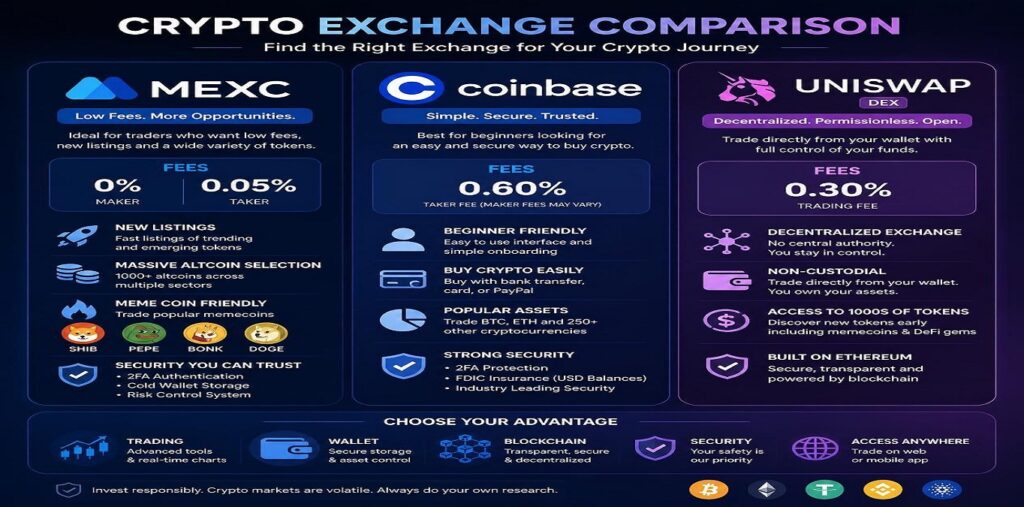
MEXC lists new tokens at a rapid pace, often ahead of Binance or Coinbase, and now also stands out as one of the cheapest exchanges to trade on.
Fees: Spot trading is 0% maker / 0.05% taker — among the lowest of any major exchange. Futures fees are similarly low at 0% maker / 0.02% taker, with further discounts for MX token holders.
Key benefits:
- Extensive catalog of altcoins and memecoins
- Regular airdrops and trading competitions
- Among the lowest spot and futures fees in the industry
- Active community and responsive support
6. Coinbase — Best for Beginners
Coinbase remains the most trusted, regulated on-ramp for U.S. traders, and its memecoin lineup has expanded significantly. It now lists SHIB, PEPE, BONK, WIF, and FARTCOIN alongside DOGE, with straightforward fiat purchase options.
Fees: Coinbase’s simple app carries higher spread-based costs, while Coinbase Advanced Trade charges around 0.60% taker for retail-sized trades noticeably higher than most other exchanges on this list, though it scales down with volume.
Why Coinbase works for beginners:
- Clean, easy-to-navigate interface
- Instant purchases via debit/credit card, PayPal, or bank transfer
- Strong security track record and regulatory compliance in the U.S.
- Now supports a wider range of major memecoins than in past years
Trade-off: Fees are meaningfully higher than competitors, and lesser-known micro-cap memecoins still won’t be found here Coinbase focuses on established, higher-liquidity tokens.
7. Uniswap (DEX) — Best for True Decentralization
For traders who value self-custody and anonymity, decentralized exchanges like Uniswap (and PancakeSwap on BNB Chain) let you swap tokens directly from your wallet , no KYC, no intermediary.
Fees: No platform trading fee beyond the standard ~0.3% liquidity-pool swap fee plus network gas costs.
Why pick a DEX:
- Earliest possible access to new memecoins, often before any centralized listing
- Works with MetaMask, Trust Wallet, and hardware wallets
- Full custody and control over your funds
Warning: Always verify contract addresses before trading, and be alert to fraudulent tokens DEXs don’t vet listings the way centralized exchanges do.
Comparison Table: Top Memecoin Trading Platforms
| Exchange | Ideal For | Spot Fees (Maker/Taker) | Stop-Loss | Regulation | Key Strength |
|---|---|---|---|---|---|
| Binance | Liquidity & speed | 0.10% / 0.10% | ✅ | Global | Deep liquidity |
| KuCoin | New listings | 0.10% / 0.10% | ✅ | Global | Early access |
| OKX | Bots & automation | 0.08% / 0.10% | ✅ | Global | Trading bots |
| Bybit | Futures & leverage | 0.10% / 0.10% | ✅ | Global | High leverage |
| MEXC | New coins & low fees | 0% / 0.05% | ✅ | Global | Cheapest fees |
| Coinbase | Beginners | ~0.60% (Advanced) | ✅ | U.S.-regulated | Trust & compliance |
| Uniswap | Decentralized users | Gas + ~0.3% pool fee | ❌ | DEX (unregulated) | No KYC, early access |
Fees reflect standard/base rates as of mid-2026 and can vary with volume tiers, native-token discounts, and promotions. Always confirm current rates directly on each platform before trading.
How to Choose the Right Exchange
When picking a memecoin trading platform, weigh these factors:
- Liquidity: Avoid low-volume markets where slippage eats into returns.
- Security: Favor exchanges with a strong track record and no major breach history.
- Tools: Confirm support for limit orders, stop-loss, and other risk-management features.
- Fees: Small percentage differences add up fast with frequent trading.
- Regulation: Especially important for U.S.-based traders navigating compliance requirements.
Final Thoughts
Memecoin trading remains as exciting as it is risky. The exchanges above each bring a different mix of liquidity, low fees, automation, or regulatory comfort the right choice depends on your trading style and risk tolerance. Whether you’re chasing the next PEPE rally or holding Dogecoin for the long haul, using stop-loss orders and sizing positions sensibly remains the best way to manage the downside of this famously volatile corner of crypto.
For more trading guides, visit CryptoPulseUSA — your go-to source for the latest insights, tools, and trends in the crypto world.