
Blockchain is no longer just a buzzword tied to cryptocurrency. Across the United States, industries like banking, healthcare, logistics, and even real estate are adopting this technology to improve trust, speed, and transparency. Understanding how blockchain operate gives you a clear edge in today’s digital economy.
For beginners, blockchain may seem complex at first. But once you break down the blockchain transaction process, it becomes surprisingly logical. This guide explains everything in simple terms so you can understand how data moves securely without a central authority.
What Is Blockchain? A Simple Explanation for Beginners
Blockchain is a decentralized ledger system that records transactions across multiple computers instead of storing them in one central place. This means no single entity controls the data, making the system more secure and transparent for everyone involved.
At its core, blockchain is built on a structure where data is stored in blocks, connected in a chain using a cryptographic hash function. Each transaction includes digital signature verification, using a private key and public key, ensuring only the rightful owner can initiate a transaction.
“Blockchain is simply a shared digital record book that cannot be changed once data is
added. Every entry is verified by a network of computers, making it a tamper-proof
data system that builds trust without intermediaries.”
Key Components of Blockchain Technology
The system relies on nodes in a blockchain network, which validate transactions, and a peer-to-peer network blockchain structure that ensures data is shared equally. Each block contains transaction data, a timestamp, and a unique hash linking it to previous blocks.
How blockchain operate: Step-by-Step Process
Understanding how blockchain works becomes much clearer when you follow a real transaction from start to finish. This expanded explanation dives deeper into the blockchain transaction process, showing exactly what happens behind the scenes when you send cryptocurrency.
Each step in this blockchain step by step flow is designed to ensure security, accuracy, and trust. From the moment a transaction begins to the final blockchain confirmation process, multiple layers of verification take place using cryptography and decentralized consensus.
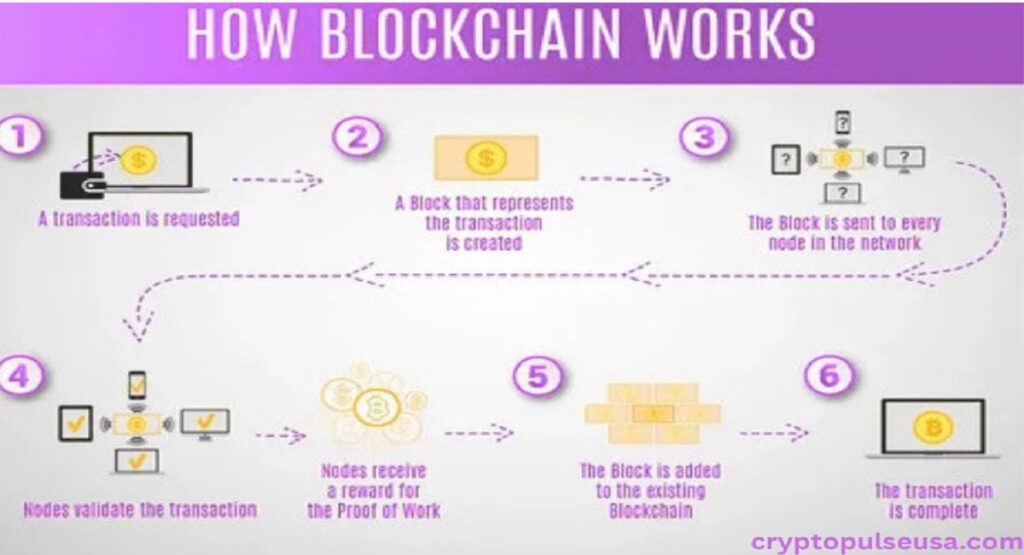
Step 1 – Transaction Initiation (How a Crypto Transaction Begins)
Every transaction starts when a user sends cryptocurrency using a wallet. This is known as transaction initiation blockchain, where the sender enters the recipient’s address, amount, and signs the transaction using their private key. This step uses digital signature verification to prove ownership.
Behind the scenes, the wallet creates a transaction message that includes the sender’s public key, recipient’s address, and a unique signature. This ensures that only the rightful owner can authorize the transaction, forming the foundation of secure transaction verification.
Step 2 – Transaction Broadcasting (Propagation Across Network)
Once initiated, the transaction is sent to a peer-to-peer network blockchain, where it spreads across thousands of nodes. This stage is called transaction propagation network, and it ensures every participant becomes aware of the new transaction.
The transaction enters a waiting area called the mempool, which stands for memory pool. Here, unconfirmed transactions are stored until validators or miners pick them. The mempool meaning blockchain is important because it acts like a queue, prioritizing transactions based on fees.
Step 3 – Blockchain Validation Process (Consensus Mechanism)
At this stage, nodes begin verifying the transaction using blockchain validation rules. They check whether the sender has enough balance, whether the digital signature is valid, and whether the transaction follows protocol rules.
This is where the blockchain consensus mechanism comes into play. In Proof of Work, miners solve complex puzzles using a nonce in blockchain, while in Proof of Stake, validators are selected based on their stake. Both methods ensure double-spending prevention and maintain network integrity.
Step 4 – Block Creation Process (Building the Data Structure)
Once validated, transactions are grouped into a block. This is part of the block creation process, where multiple transactions are bundled together to form a unit of data within the blockchain data structure.
Each block contains important details such as a block header and metadata, including the previous block’s hash, a timestamp, and a Merkle root. The timestamp in blockchain ensures chronological order, making the ledger reliable and traceable.
Step 5 – Adding the Block to Blockchain (Hashing & Linking)
After a block is created, it is added to the blockchain by linking it to the previous block using a cryptographic hash function. This forms a continuous chain, ensuring that any attempt to alter data would break the entire sequence.
This step explains how blocks are added to blockchain and why the system is considered an immutable ledger. Once added, the data becomes permanent and cannot be changed, reinforcing blockchain security explained in practical terms.
Step 6 – Blockchain Confirmation Process (Final Verification & Rewards)
The final step is the blockchain confirmation process, where the transaction is officially completed. Multiple confirmations may occur as new blocks are added, increasing trust and security.
During this stage, miners or validators receive rewards such as miner rewards blockchain, transaction fees, or validator rewards proof of stake. This crypto incentives system motivates participants to maintain the network honestly and efficiently.
Blockchain Technology vs Cryptocurrency
Many beginners think blockchain and cryptocurrency are the same, but they serve very different purposes. Blockchain is the underlying technology, while cryptocurrency is just one application built on top of it. Understanding this difference is key to fully grasping how crypto transactions work.
Blockchain acts as a decentralized ledger system that records and verifies all transactions. Cryptocurrency, on the other hand, is a digital asset that uses this system to transfer value securely. This distinction helps explain why blockchain has uses far beyond digital money.
Blockchain Technology Explained in Depth
Blockchain is a system that stores data in a secure, transparent, and distributed way. It uses cryptographic security blockchain principles to ensure that every transaction is verified and recorded accurately across all nodes.
This technology supports various applications such as smart contracts, supply chain tracking, and digital identity systems. Its strength lies in its ability to create a tamper-proof data system where trust is built through code rather than intermediaries.
Cryptocurrency Explained (How It Uses Blockchain)
Cryptocurrency is a digital currency that operates on blockchain networks. When you send Bitcoin or Ethereum, you are initiating a blockchain network transaction that follows the full cryptocurrency transaction flow discussed earlier.
Each transaction involves fees, known as blockchain transaction fees, which incentivize miners or validators. For example, the bitcoin block reward is given to miners who successfully add new blocks, ensuring the system remains active and secure.
Key Differences Between Blockchain and Cryptocurrency
| Aspect | Blockchain Technology | Cryptocurrency |
|---|---|---|
| Definition | Distributed ledger system | Digital currency |
| Purpose | Record and verify data | Transfer value |
| Usage | Multiple industries | Financial transactions |
| Dependency | Independent technology | Depends on blockchain |
Simple Analogy to Understand the Difference
Think of blockchain as a railway system and cryptocurrency as the trains running on it. The railway provides the infrastructure, while trains carry passengers or goods. Similarly, blockchain supports many applications, while cryptocurrencies are just one use case.
Benefits of Blockchain Technology in Real-World Applications
Blockchain offers strong advantages such as fraud prevention blockchain, faster transactions, and improved trust. Its ability to secure data using cryptography makes it ideal for sensitive industries.
In the real world, blockchain is used in finance, healthcare, logistics, and digital identity systems. These applications show how versatile and powerful the technology has become.
Drawbacks and Challenges of Blockchain Technology
Despite its benefits, blockchain faces several limitations. Scalability is a major concern, as networks can slow down when handling large volumes of transactions.
Energy consumption is another issue, especially in systems using Proof of Work. Regulatory uncertainty in the USA also creates barriers to adoption and innovation.
Real-World Uses of Blockchain in the United States
Blockchain is already transforming industries across the USA. Financial institutions use it for faster settlements, while supply chains use it to track goods with complete transparency.
A simple case study shows how Walmart uses blockchain to track food products. This reduces contamination risks and improves safety by identifying sources within seconds instead of days.
The Future of Blockchain Technology in 2026 and Beyond
The future of blockchain looks promising as adoption continues to grow. Integration with AI and Web3 is creating smarter and more automated systems.
Governments and enterprises are exploring blockchain for digital identity and secure data storage. These trends indicate that blockchain will become a core part of digital infrastructure.
Conclusion – Why Blockchain Matters More Than Ever
Understanding how blockchain works is essential in today’s digital world. It is not just about cryptocurrency but about building trust in a decentralized environment.
As technology evolves, blockchain will play a key role in shaping the future of finance, data security, and digital interactions. Learning it today prepares you for tomorrow’s opportunities.
FAQ
How does a blockchain transaction work step by step?
A blockchain transaction begins when a user sends cryptocurrency using a wallet. The request is broadcast to a network of nodes, verified through a blockchain validation process, grouped into a block, and then added to the chain. Finally, it becomes permanent through the blockchain confirmation process.
How blockchain verifies transactions?
Blockchain uses digital signature verification, cryptographic keys, and consensus mechanisms like Proof of Work or Proof of Stake. Nodes check if the sender has enough balance and validate the transaction before approving it, ensuring secure transaction verification.
What is the mempool in blockchain?
The mempool is a temporary storage area where unconfirmed transactions wait before being processed. When you send crypto, your transaction stays in the mempool until miners or validators pick it for inclusion in a block.
Why are blockchain transactions secure?
Blockchain transactions are secured using cryptographic hash functions, decentralization, and consensus mechanisms. Once recorded, data becomes part of an immutable ledger, making it nearly impossible to alter or hack.
How long does blockchain confirmation take?
The time depends on the network. Bitcoin transactions may take 10–60 minutes, while some modern blockchains confirm transactions in seconds. More confirmations increase security and reliability.
What is the difference between blockchain and cryptocurrency?
Blockchain is the technology that records transactions, while cryptocurrency is a digital asset that uses blockchain to transfer value. Blockchain has many uses beyond crypto, such as supply chains and digital identity.
Can blockchain be hacked?
Blockchain itself is highly secure due to decentralization and encryption. However, vulnerabilities can exist in wallets or exchanges, not in the core blockchain network transaction system.
What is proof of work vs proof of stake?
Proof of Work uses computing power to validate transactions, while Proof of Stake selects validators based on their holdings. Both are types of blockchain consensus mechanisms used to maintain network integrity.






Leave a Reply