
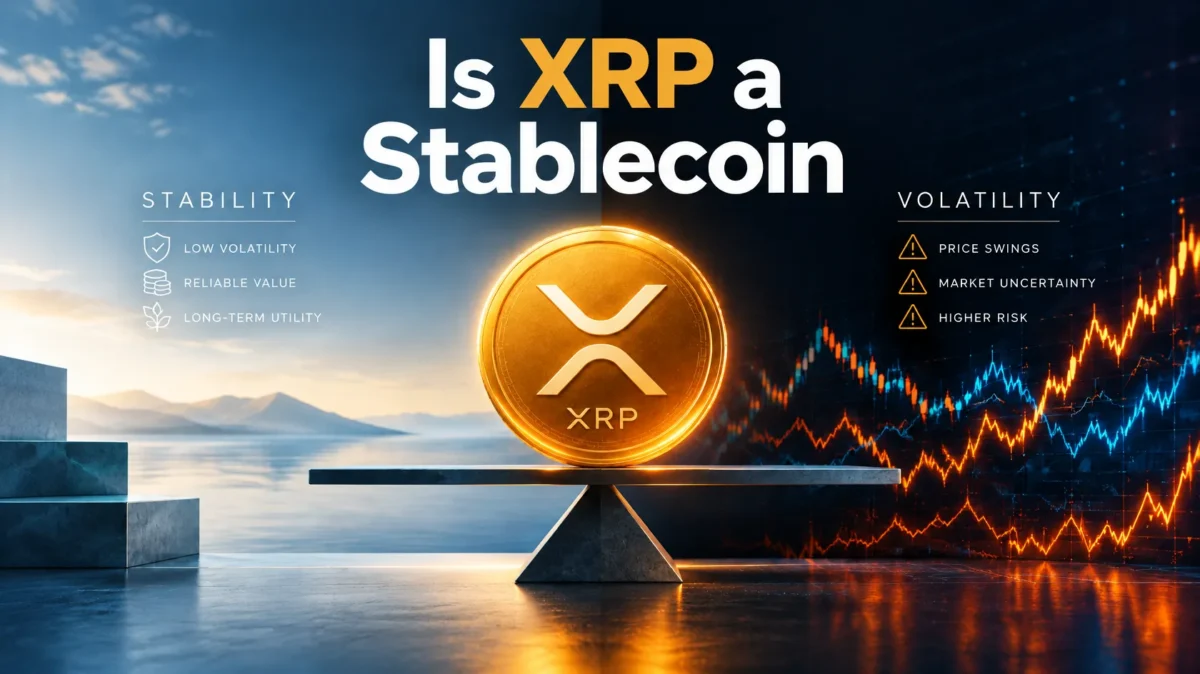
Is XRP a stablecoin? No. XRP is not a stablecoin. Its price moves with supply and demand, while a stablecoin is built to hold a fixed value, usually $1. The confusion comes from RLUSD, Ripple’s separate dollar stablecoin, which is a different asset from XRP.
Key Takeaways
- XRP is not a stablecoin. Its price floats and can fall as well as rise.
- XRP is the native asset of the XRP Ledger (XRPL). It pays network fees and can serve as a bridge asset between currencies.
- RLUSD is Ripple’s stablecoin. It targets about $1 and is backed by reserves.
- They are different assets. They can run on the same network but do different jobs.
- Ethereum’s ETH is not a stablecoin either, for the same reason.
- Stablecoins are not risk-free. Reserves, redemption terms, and the issuer all matter.
What Makes a Coin a Stablecoin?
A stablecoin is a crypto token designed to hold a steady price, most often $1. To judge any coin, ask four questions:
- Does it target a fixed price? Stablecoins aim at a set value, such as one U.S. dollar.
- What backs it? Most dollar stablecoins hold reserves such as cash and short-term government securities. Others use crypto collateral or code-based mechanisms, which carry different risks.
- Can you redeem it? A real stablecoin comes with a way to exchange it back for dollars, though often only for approved customers of the issuer.
- Who is the issuer, and can you verify the reserves? Look for published attestations or reports.
Main Types of Stablecoins
- Fiat-backed: Supported by reserves such as cash, bank deposits, and short-term government securities. Examples include USDC and RLUSD.
- Crypto-backed: Use other cryptocurrencies as collateral, often overcollateralized because the collateral itself fluctuates. DAI is a well-known example, though its collateral structure is now broader than crypto alone.
- Algorithmic: Try to hold a target price through automated supply adjustments and incentives rather than traditional reserves. They can carry substantial risk when confidence and liquidity disappear.
For more detail, read our guide on how stablecoins maintain their peg.
Why XRP Does Not Pass the Test
XRP fails all four questions:
- No price target. XRP trades freely on exchanges, so its price changes with demand, liquidity, regulation, and market sentiment. Check a live tracker such as CoinMarketCap or CoinGecko and you will see it move daily.
- No reserves behind it. No pool of dollars sits behind each XRP.
- No redemption at $1. Nobody is obliged to swap one XRP for a dollar. To get dollars you sell or exchange it, and the result depends on the market price, liquidity, and fees.
- No issuer promising stability. XRP is the native asset of an open-source network. Ripple, the company, is separate from the ledger and does not guarantee XRP’s value.
Because its value is set by the market, XRP can lose value quickly. Anyone buying it expecting a steady $1 would be making a serious mistake.
A useful way to keep the terms straight:
- Ripple is a technology and payments company.
- XRP is a digital asset.
- XRPL is the blockchain network.
- RLUSD is a separate dollar-backed stablecoin.
See our guides on what Ripple and XRP are and Ripple vs. XRP.
What Is XRP Actually Used For?
XRP is the native asset of the XRP Ledger, an open-source blockchain network launched in 2012 and designed for fast, low-cost value transfers.
- Paying transaction fees. A small amount of XRP is destroyed (burned) with each transaction, which helps deter spam. The standard fee is not paid to validators. See the XRPL transaction cost documentation.
- Acting as a bridge asset. Where two currencies lack a liquid direct market, a payment route can pass through XRP (Currency A → XRP → Currency B). XRP is not used in every cross-border payment; the route depends on the provider, liquidity, and costs.
- Supporting payments and tokens. The ledger handles XRP, issued tokens (including stablecoins), and decentralized exchange functions. Its consensus mechanism validates transactions without mining.
What Is RLUSD? Ripple’s Actual Stablecoin
RLUSD is a U.S. dollar-backed stablecoin introduced in December 2024 and designed to hold about $1 per token. Unlike XRP, it uses a reserve-backed structure. Ripple states that RLUSD is backed by U.S. dollar deposits, U.S. Treasury securities, and cash equivalents. The designated issuer, Ripple Custody & Trust Company, is chartered and supervised by the New York State Department of Financial Services (NYDFS) as a limited-purpose trust company, and Ripple publishes monthly independent reserve attestations.
Review the issuer’s information and reports on the official RLUSD transparency page.
Where Does RLUSD Operate?
RLUSD is issued natively on the XRP Ledger and is also available as an ERC-20 token on Ethereum and other supported EVM-compatible networks. The versions on different networks are issued for different environments, and sending a token to an incompatible network or address can result in lost funds. Check the official supported networks documentation before any transfer.
RLUSD Reserve Snapshot
Ripple’s transparency page reported these figures as of November 19, 2026:
| Reserve information | Reported amount |
|---|---|
| RLUSD in circulation | $2.8192 billion |
| RLUSD reserve funds | $2.9635 billion |
| Reporting date | November 19, 2026 |
Reserves exceeded circulating supply on that date. These figures change as RLUSD is issued and redeemed, so always check the latest report rather than treating this snapshot as current.
XRP vs. RLUSD vs. USDC
| Feature | XRP | RLUSD | USDC |
|---|---|---|---|
| Asset type | Native cryptocurrency | Fiat-backed stablecoin | Fiat-backed stablecoin |
| Price target | None | $1 | $1 |
| Price behavior | Floats with the market | Designed to track USD | Designed to track USD |
| Reserve backing | None | Cash and cash equivalents | Cash and cash equivalents |
| Issuer | No issuer | Ripple Custody & Trust Company (NYDFS-regulated) | Circle |
| Redeem for $1? | No | Via the issuer, subject to eligibility | Via Circle, subject to eligibility; individuals usually go through exchanges |
| Main networks | XRP Ledger | XRP Ledger, Ethereum, and others | Many networks |
| Main purpose | Network fees and bridge liquidity | Digital dollar payments and settlement | Digital dollar payments and settlement |
Which is more stable? RLUSD and USDC are designed to hold about $1; XRP has a floating price. That makes stablecoins better suited to balances where you want to avoid dollar-value swings, while XRP serves a different role. The assets are not interchangeable.
Can XRP and Stablecoins Work Together?
Yes. The XRP Ledger supports both native XRP and issued tokens such as RLUSD. A user might hold RLUSD for dollar-denominated value, while XRP pays ledger fees or acts as an intermediate asset in some conversion routes. RLUSD does not make XRP more stable, and it does not replace XRP. Analysts disagree on how the two will interact in cross-border payments, and that debate is unsettled.
Why Do People Think XRP Is a Stablecoin?
- The name. People say “Ripple’s stablecoin” and assume it means XRP.
- RLUSD. It lives in the same ecosystem as XRP, so headlines often mention both.
- XRP’s payments focus. A coin built for moving money sounds like it should hold steady value. But payment speed and price stability are separate traits: a transfer can settle in seconds while the asset’s value keeps fluctuating.
Does Volatility Matter for Cross-Border Payments?
Yes. If a provider uses XRP as an intermediate asset, its value can change between acquiring it and converting it to the destination currency. Exposure depends on settlement time, liquidity, slippage, market volatility, and whether the provider hedges. Fast settlement shortens the exposure window but does not remove the risk, and XRP is not guaranteed to be the cheapest route for every payment.
Is Ethereum a Stablecoin?
No. Ether (ETH) is the native asset of Ethereum and its price floats, like XRP. Some stablecoins, including USDC and RLUSD, run as tokens on Ethereum, which is another reason beginners mix them up.
Is a Stablecoin a Cryptocurrency?
Yes. A stablecoin is a type of crypto asset, usually a token on a blockchain. The difference from XRP or Bitcoin is the design goal: stability instead of price growth. XRP is generally classed as an altcoin, meaning any cryptocurrency other than Bitcoin.
Can XRP Become a Stablecoin?
Nothing in XRP’s current design ties it to a dollar price. For XRP itself to act as a dollar stablecoin it would need a fundamentally different backing and stabilization arrangement. Ripple’s approach has been to issue a separate token, RLUSD, rather than change XRP.
Risks to Know
XRP risks
- Price volatility: it can drop sharply in a short time.
- Liquidity risk: large trades may face slippage.
- Regulatory uncertainty: rules and market access can change.
- Platform risk: wallets and exchanges can suffer outages or security problems.
Stablecoin risks
- Depegging: a stablecoin can trade below its target, temporarily or permanently.
- Reserve and issuer risk: the quality of the backing and the reliability of the issuer matter.
- Redemption risk: direct redemption may depend on eligibility and issuer terms.
- Blockchain risk: congestion, smart-contract bugs, and transfer mistakes can affect access.
A stablecoin’s $1 target is not the same as a bank deposit or a guarantee against loss.
Scams. Fake “XRP stablecoin” tokens and support-number scams exist. Never call a phone number you found in search results, and double-check any token contract on the issuer’s official site.
How to Check Whether Any Coin Is a Stablecoin
- Price target? Is it designed to track USD or another asset?
- What backs it? Cash, government securities, crypto collateral, or another mechanism?
- Who issues it? Can you identify the responsible issuer or protocol?
- Can it be redeemed? Read the terms and eligibility requirements.
- Are reserve reports available? Can the backing be independently verified?
Taxes
The IRS generally treats digital assets as property. Selling or trading XRP can create a taxable gain or loss, and you must report digital asset income, gains, and losses whether or not you receive a Form 1099-DA. Stablecoin transactions can also be reportable, and a small price difference does not make a transaction tax-free. Read the IRS FAQ on digital asset transactions and talk to a tax professional about your situation.
Frequently Asked Questions
Is XRP a stablecoin or an altcoin? XRP is an altcoin. It is not a stablecoin because its price floats.
Is XRP pegged to the U.S. dollar? No. There is no peg, and no guarantee that one XRP will equal one dollar.
Does Ripple have a stablecoin? Yes. It is called RLUSD, a separate dollar-backed token.
Is RLUSD the same as XRP? No. RLUSD targets $1 and has an issuer and reserves. XRP has neither, and its price changes constantly.
Is XRP backed by cash or Treasuries? No. RLUSD is backed by reserve assets, according to its issuer. XRP is not.
Can I use XRP to make payments? Yes, XRP can be sent over the XRP Ledger and used in some payment and conversion routes, but speed and price stability are different things.
Can XRP lose value? Yes. It can lose value when demand falls or market conditions change.
Is RLUSD safer than XRP? They have different risk profiles. RLUSD is designed to reduce price volatility but carries issuer, reserve, redemption, and network risks. XRP carries market-price volatility. Neither is risk-free.
Is Ethereum a stablecoin? No. ETH is the native asset of Ethereum and its price floats.
Is a stablecoin a cryptocurrency? Yes. It is a crypto token designed to hold a steady value.
Final Thoughts
XRP is a volatile crypto asset; RLUSD is Ripple’s stablecoin. If you need a steady dollar value, look at stablecoins and check the issuer’s reserves. If you want XRP, accept that its price will move. Either way, only use money you can afford to lose, and check each platform’s fee and availability pages before you act.
Disclaimer: This article is for educational and informational purposes only and is not financial, investment, legal, or tax advice. Crypto assets are volatile and you can lose money.
Sources
- Ripple, RLUSD transparency reports
- Ripple, RLUSD supported networks
- XRP Ledger documentation, xrpl.org
- Circle, USDC transparency
- IRS, digital asset transactions FAQ





Leave a Reply