
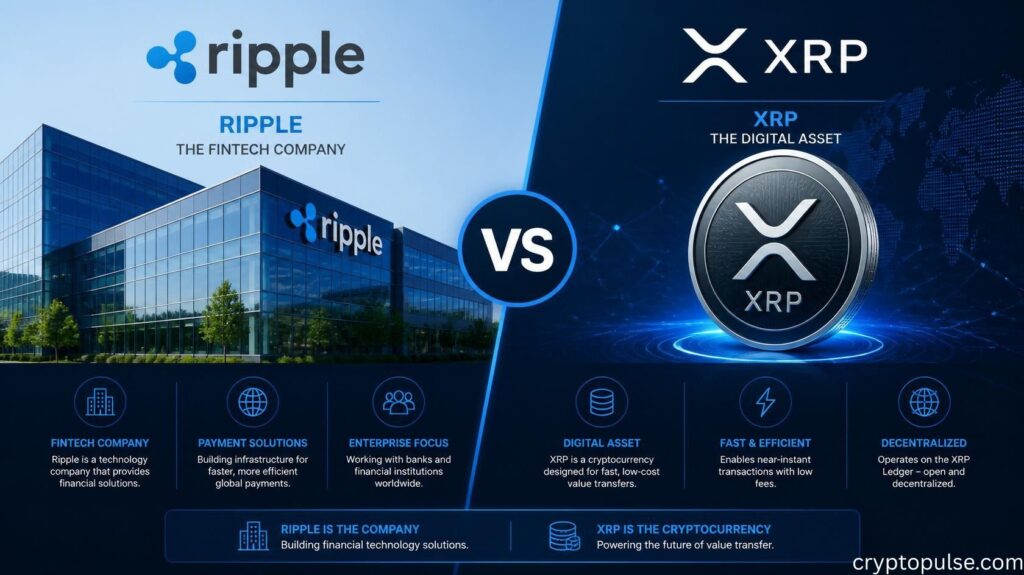
Many beginners entering the cryptocurrency world often hear the words Ripple and XRP used together. Because of this, many people assume they are the same thing.
However, Ripple and XRP are two different things.
Ripple is a technology company that develops blockchain-based payment solutions, while XRP is a digital cryptocurrency that operates on the XRP Ledger.
Understanding the difference between Ripple, XRP, and XRP Ledger is important because it helps investors, beginners, and crypto enthusiasts understand how this technology actually works.
Ripple vs XRP
| Feature | Ripple | XRP |
|---|---|---|
| Type | Technology company | Cryptocurrency |
| Purpose | Builds payment solutions | Transfers value digitally |
| Created | 2012 | 2012 |
| Main Focus | Financial infrastructure | Fast transactions |
| Controlled By | Ripple company | Open-source XRP Ledger |
| Used For | Enterprise payment solutions | Digital asset transfers |
Simple explanation:
Ripple = Company
XRP = Cryptocurrency
XRP Ledger = Blockchain network
What Is Ripple?
Ripple is a financial technology company focused on improving global payment systems.
The company develops blockchain-based solutions designed to help financial institutions move money internationally faster and more efficiently.
Traditional international payments often depend on multiple banking intermediaries. Ripple aims to simplify this process by providing technology that allows faster settlement and improved liquidity management.
Ripple’s solutions focus mainly on:
- Banks
- Payment providers
- Financial institutions
- Enterprise customers
The company does not operate like a traditional cryptocurrency exchange or wallet provider.
Instead, Ripple builds payment infrastructure.
What Is XRP?
XRP is a digital cryptocurrency that runs on the XRP Ledger.
Unlike Bitcoin, which was created mainly as a decentralized alternative to traditional money, XRP was designed with payments and liquidity in mind.
XRP allows users and institutions to:
- Transfer value quickly
- Send international payments
- Reduce transaction costs
- Exchange currencies efficiently
The XRP Ledger can process transactions within seconds, making XRP one of the faster digital assets available.
What Is XRP Ledger (XRPL)?
The XRP Ledger is the blockchain network that supports XRP transactions.
It is a decentralized system that allows users to send, receive, and exchange XRP without requiring a central authority to approve every transaction.
Unlike Bitcoin’s mining system, XRP Ledger uses a consensus mechanism to validate transactions.
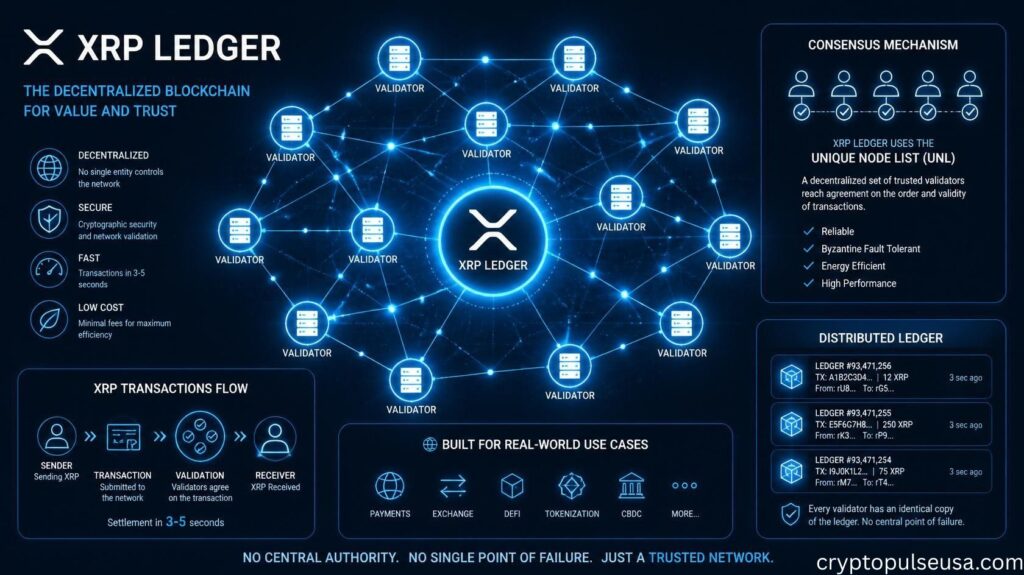
Key features of XRP Ledger include:
Fast Transactions
XRP transactions typically settle within seconds.
Low Fees
Transaction costs are extremely small compared with traditional payment networks.
Energy Efficiency
The XRP Ledger does not rely on energy-intensive mining.
Decentralized Validation
Transactions are confirmed through a network of independent validators.
How Are Ripple and XRP Connected?
Ripple and XRP are connected because Ripple helped develop and promote technology related to the XRP ecosystem.
However, XRP is not the same as Ripple.
A simple example:
Imagine a company creating a smartphone.
The company is similar to Ripple.
The smartphone operating system is similar to XRP Ledger.
The digital service running on that system is similar to XRP.
They are connected, but they are not identical.
Does Ripple Own XRP?
This is one of the most common questions.
Ripple has historically held a significant amount of XRP, but XRP itself exists on the XRP Ledger, which operates separately from the company.
The XRP Ledger is open-source, meaning developers and organizations can interact with the network independently.
The relationship between Ripple and XRP has been widely discussed in the cryptocurrency community, especially regarding questions about ownership and decentralization.
Is XRP Controlled by Ripple?
No, XRP is not controlled like a company stock.
XRP operates on the XRP Ledger, which uses a decentralized validation process.
However, some critics argue that Ripple’s large XRP holdings give the company significant influence over the ecosystem.
Supporters argue that the XRP Ledger remains independent because transactions are validated by network participants.
This debate is one of the reasons XRP continues to receive attention in the crypto industry.
Ripple vs XRP: Key Differences Explained
1. Ripple Is a Company, XRP Is an Asset
The biggest difference:
Ripple creates technology.
XRP is the cryptocurrency used for transferring value.
2. Ripple Works With Businesses
Ripple focuses on enterprise solutions, including payment infrastructure for financial organizations.
XRP can be used by anyone with access to the network.
3. Ripple Does Not Need XRP for Every Product
Some Ripple products may use blockchain technology without requiring XRP.
This is why Ripple and XRP should not always be considered identical.
4. XRP Exists Independently
Even if Ripple did not exist, the XRP Ledger and XRP cryptocurrency could continue operating.
Why Do People Confuse Ripple and XRP?
There are several reasons:
Similar Names
For years, many people used “Ripple” when referring to XRP.
Media Coverage
News articles often mention Ripple when discussing XRP price movements.
Shared History
Ripple and XRP were introduced around the same time, creating confusion.
Marketing
Early cryptocurrency discussions often connected the company and the cryptocurrency closely.
Ripple vs XRP vs XRP Ledger: Simple Comparison
| Term | Meaning |
|---|---|
| Ripple | Blockchain payment company |
| XRP | Digital cryptocurrency |
| XRP Ledger | Blockchain network powering XRP |
Remember:
Ripple builds payment technology.
XRP transfers value.
XRP Ledger processes transactions.
Why Does This Difference Matter for Investors?
Understanding the difference helps investors make better decisions.
If someone says:
“Ripple announced a partnership.”
That does not automatically mean:
“XRP price will increase.”
Company developments, cryptocurrency adoption, and market prices are related but separate factors.
XRP price depends on:
- Market demand
- Crypto market cycles
- Investor sentiment
- Adoption
- Regulations
Ripple vs XRP: Which One Should Beginners Focus On?
For cryptocurrency investors, XRP is the asset they can buy, hold, or use.
Ripple is a company that develops financial technology solutions.
Therefore:
If you are researching cryptocurrency investment → focus on XRP.
If you are studying blockchain payment companies → research Ripple.
Both are connected, but they represent different things.
Final Thoughts
Understanding the difference between Ripple and XRP removes one of the biggest sources of confusion for cryptocurrency beginners.
Ripple is a fintech company focused on improving global payment infrastructure, while XRP is the digital asset that operates on the XRP Ledger.
Although they share history and are closely connected, they are not the same.
Before investing in XRP, beginners should understand:
- XRP is not company stock
- Ripple is not the cryptocurrency itself
- XRP Ledger is the technology behind XRP
- Cryptocurrency investments involve risks
Learning these differences helps you make more informed decisions and better understand the role XRP plays in the broader blockchain ecosystem.
Is Ripple the same as XRP?
No. Ripple is a technology company, while XRP is a cryptocurrency that operates on the XRP Ledger.
Why do people call XRP Ripple?
Many people use Ripple and XRP interchangeably because they were introduced together and have a shared history. However, they are separate.
Can Ripple control XRP?
Ripple cannot directly control every XRP transaction. XRP operates through the XRP Ledger, which uses a network-based validation system.
Is XRP owned by Ripple?
Ripple has owned significant XRP holdings, but XRP itself is a digital asset that exists on the XRP Ledger.
Which is better: Ripple or XRP?
They are not competitors. Ripple is a company, while XRP is a cryptocurrency. The answer depends on whether you are researching blockchain companies or digital assets.






Leave a Reply