
Cryptocurrency gives you something traditional finance never could full control over your money. But with that control comes real responsibility. A single mistake like losing your recovery phrase or sending funds to the wrong network can result in permanent loss. That’s why understanding crypto wallets isn’t optional anymore, it’s essential.
This guide goes beyond basic definitions. You’ll learn how crypto wallets actually work, how to set one up step-by-step, how to avoid beginner mistakes, how fees work, and how users in USA and similar regions can navigate crypto safely.
What Is a Crypto Wallet?
A crypto wallet is a tool that allows you to access, manage, and control your cryptocurrency by storing your private keys.
Here’s the most important concept beginners often misunderstand:
- Your crypto is not stored in your wallet
- It exists on the blockchain
- Your wallet simply gives you access and control
Think of it like this:
- Blockchain = global digital ledger
- Wallet = your secure login credentials
Without your private keys, you cannot access your funds—even though they still exist on the blockchain.
Important Points
- Access to crypto assets is made possible by a crypto wallet, which might be paper, software, hardware, or Web-based.
- ‘Hot’ and ‘Cold’ wallet terms used for crypto wallets are actual mean is ‘online’ and ‘offline’
- What kind of cryptocurrency wallet is best for you depends on your own preferences.
Kinds of Crypto Wallets
There are various types of crpto wallets:
Hardware Wallet
A hardware wallet is a tool or device used to store private keys for cryptocurrencies in an offline, “cold” manner. Crypto hardware wallets are offline by default, but they can be connected to the Internet to transfer and receive digital assets. Hardware wallets are usually non-custodial, which means that the assets in the wallet are only under the care of the cryptocurrency owner.
Software Wallet
A bitcoin software wallet operates on one or more of your devices and is a digital tool. Software wallets are referred to as ‘hot’ when they have access to the internet. For non-custodial software wallets, the user has complete authority over their online assets.
Web-based Wallet
A bitcoin software wallet operates on one or more of your devices and is a digital tool. Software wallets are referred to as ‘hot’ when they have access to the internet. For non-custodial software wallets, the user has complete authority over their online assets.
Paper Wallet
The finest offline wallets are paper wallets, which are non-custodial cryptocurrency wallets that are not hosted. The term “cold” refers to these wallets. In a paper wallet, the private keys are just printed on paper. Paper wallets may contain QR codes to facilitate Internet access.
You need a bitcoin wallet to ensure safe, uninterrupted, and unrestricted access. Choose your cryptocurrency wallet carefully.
Step-by-Step: How to Create Your First Crypto Wallet
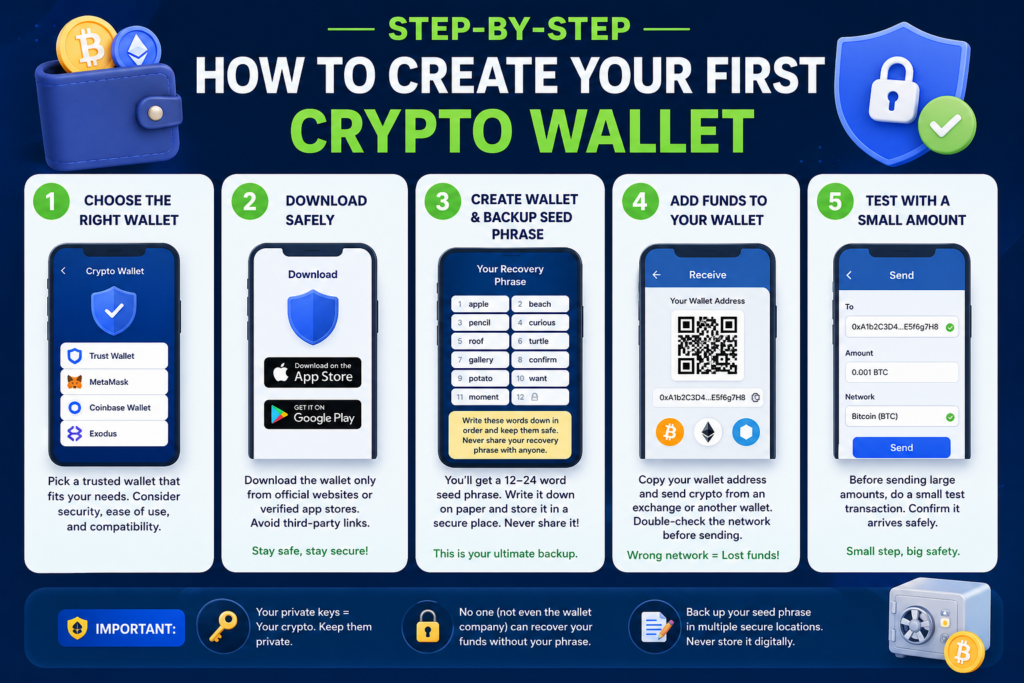
Here’s a practical beginner walkthrough:
Step 1: Choose a Trusted Wallet
Look for:
- High ratings
- Strong security features
- Beginner-friendly interface
Avoid unknown apps or new platforms.
Step 2: Download from Official Sources
Only use:
- Official websites
- Verified app stores
Many beginners lose money by installing fake apps.
Step 3: Secure Your Seed Phrase
When you create a wallet, you’ll receive a 12–24 word recovery phrase.
This is the most important part of your wallet.
Best practices:
- Write it on paper
- Store it in a safe place
- Never share it
Losing this means losing access forever.
Step 4: Add Funds Safely
- Copy your wallet address
- Send crypto from exchange
Always double-check:
- Wallet address
- Blockchain network
Step 5: Test Before Large Transfers
Send a small amount first.
Confirm it arrives correctly before sending larger funds.
This simple step prevents major losses.
Cryptocurrency Storage Best Practices
For substantial assets, use a hardware wallet.
- Your personal keys are protected from online threats by being saved offline in hardware wallets like Trezor or Ledger.
Retain several backends of your restoration phrase.
- Put it on paper and place it in a safe that can withstand fire.
- Don’t store it on electronic storage devices or online services.
Turn on 2FA (two-factor authentication)
- Turn on 2FA for any digital wallet or exchange to increase security.
Update the software for your wallet frequently
- Security patches address flaws that hackers could take advantage of.
Use Small Transactions to Test Initially.
- Always try sending a modest quantity of cryptocurrency to a new wallet before sending larger amounts.
How Crypto Wallets Work
Understanding this properly will protect you from major mistakes.
Public Key vs Private Key
Every crypto wallet generates two keys:
- Public key (wallet address):
This is what you share to receive crypto. It works like an account number. - Private key:
This is your secret password. It proves ownership and allows you to authorize transactions.
Anyone who gets your private key can control your funds. There is no recovery system.
What Happens When You Send Crypto?
When you send cryptocurrency, this is what happens:
- Your wallet creates a transaction
- It signs it using your private key
- The blockchain network verifies it
- The transaction is added to a block
- The receiver gets the funds
This process is fast, but irreversible. If you make a mistake, you cannot undo it.
Common Crypto Wallet Mistakes (Avoid These)
These are the most frequent and costly beginner errors:
- Losing your recovery phrase
- Clicking phishing links
- Sending funds to wrong networks
- Installing fake wallet apps
- Keeping all funds in one wallet
- Ignoring security updates
- Falling for scams and fake giveaways
Most crypto losses happen due to human error,not hacking.
Extra Security Tips
- Hold a multi-signature wallet for added security.
- Save backup tools in different physical places.
- keep wallet information confidential — avoid sharing assets or personal keys or passwords in public
How to Keep Your Crypto Wallet Safe
Keeping your crypto wallet safe is not just about technology—it’s about discipline, awareness, and smart habits. Unlike traditional banking systems, there is no customer support to recover your funds if something goes wrong. That means security is entirely your responsibility. Start by using strong, unique passwords and enabling all available protection features such as biometric locks or two-factor authentication where supported. Avoid accessing your wallet on public Wi-Fi networks, as these can expose your data to attackers. Always download wallet applications from official websites or verified app stores, and regularly update them to protect against vulnerabilities.
Equally important is understanding how scams work. Many beginners lose funds not because of hacking, but due to phishing attacks, fake apps, or social engineering tactics. Scammers often create urgency or offer unrealistic rewards to trick users into revealing their private keys or recovery phrases. You should never share your private key or seed phrase with anyone—not even someone claiming to be support staff. A safe backup strategy is also essential: write your recovery phrase on paper and store it in at least two secure locations, ideally protected from fire and water damage. By combining strong technical practices with cautious behavior, you can significantly reduce your risk and keep your digital assets secure.
Backup Strategy
- Store seed phrase in multiple secure places
- Avoid digital storage
- Consider physical protection (safe/fireproof box)
What Can You Actually Do With a Crypto Wallet?
A crypto wallet is more than storage,it’s your gateway to Web3.
You can:
- Send and receive payments globally
- Use DeFi apps for earning and lending
- Buy and store NFTs
- Stake crypto for passive income
- Participate in airdrops
This is where crypto becomes powerful and useful.
Best Crypto Wallets for Beginners
Popular beginner-friendly options include:
- Trust Wallet – Simple and mobile-friendly
- MetaMask – Best for Ethereum and DeFi
- Coinbase Wallet – Easy for beginners
- Ledger – Hardware wallet for maximum security
Choose based on your goals: convenience vs security
Final Thoughts: Start Small, Stay Safe
Crypto wallets open the door to a new financial system where you are in full control—but that freedom comes with responsibility. The best approach for beginners is to start small and learn gradually rather than rushing in with large investments. Take time to understand how transactions work, test transfers with small amounts, and become comfortable with your wallet before handling significant funds. This learning phase is critical and can prevent costly mistakes.
As you gain confidence, always keep security as your top priority. The crypto space is full of opportunities, but it also requires a mindset of caution and continuous learning. Stay updated on new threats, avoid shortcuts, and never compromise on safety practices. Remember, in crypto, there are no second chances every decision matters. If you build good habits early, you’ll not only protect your assets but also position yourself to fully benefit from the growing world of digital finance.
FAQs
What is a crypto wallet?
A tool that stores private keys and allows you to manage cryptocurrency.
What happens if I lose my seed phrase?
You permanently lose access to your crypto.
What is the safest wallet type?
Cold wallets (hardware wallets) offer the highest security.
Do I need a wallet to use crypto?
Yes, if you want full control over your funds.
What are gas fees?
Fees required to process blockchain transactions.







Leave a Reply